
The place for all your outdoor living space!

Article Overview
- Quick Answer
- What Is a Pier?
- What Is a Dock?
- Piers vs Docks: Side-by-Side Comparison
- The Regional Language Problem Nobody Explains
- The Permit Reality Nobody Talks About
- Real Cost Breakdown
- Materials: What Holds Up Over Time
- Does a Pier or Dock Actually Add Property Value?
- Can You Have Both?
- Piers, Docks, Wharves, and Jetties: The Complete Picture
- How to Choose: Pier or Dock?
- Five Things Other Articles Don't Tell You
- Frequently Asked Questions
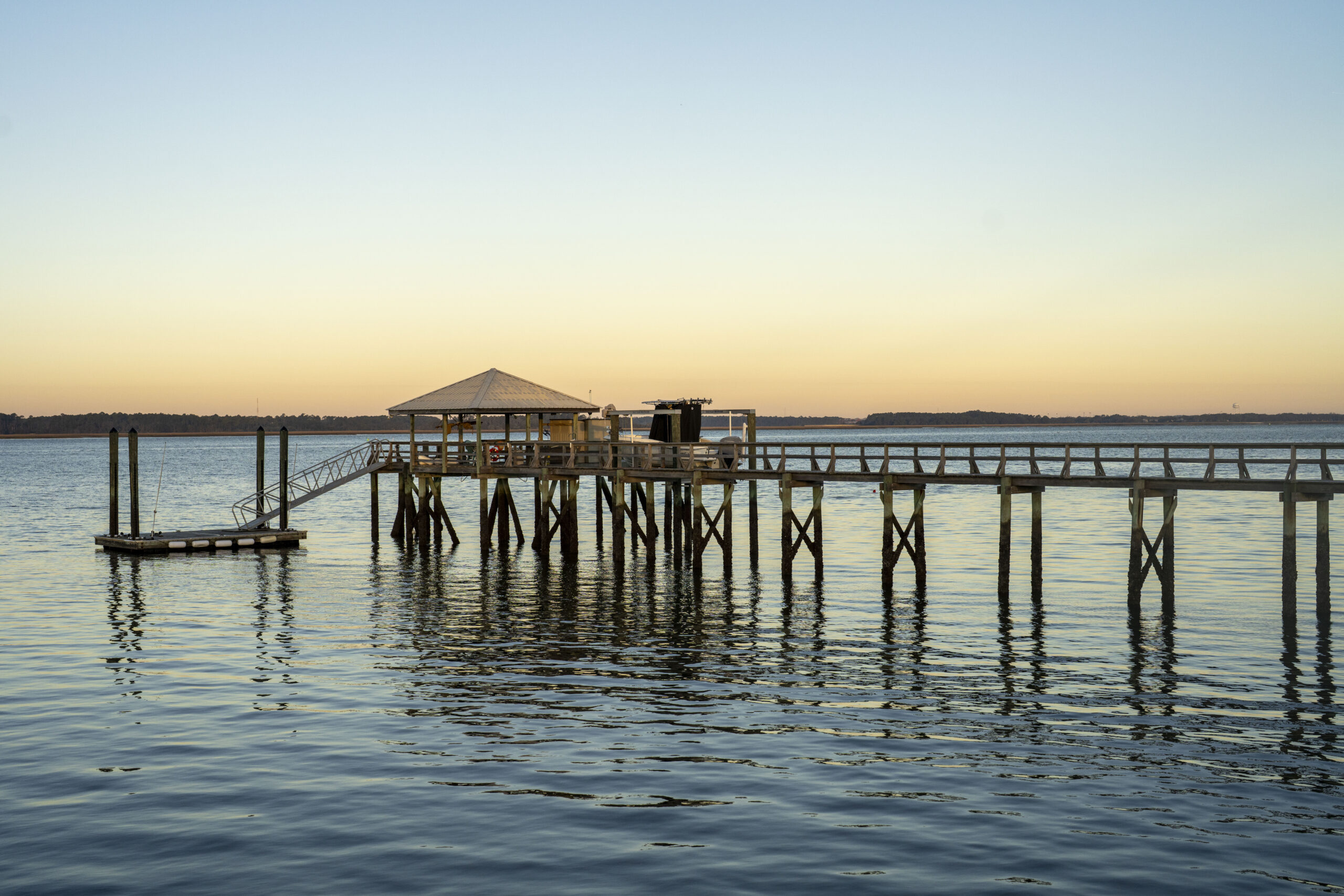
Piers vs docks – most people use the two terms to mean the same thing. Walk to the end of either one, drop a fishing line – works fine either way. But if you’re planning to build, buying a waterfront property, or pulling a permit, the distinction stops being academic and starts costing (or saving) you real money.
Here’s what actually separates a pier from a dock, why it matters for your waterfront project, and what every other article on this topic misses entirely.
What Is a Pier?
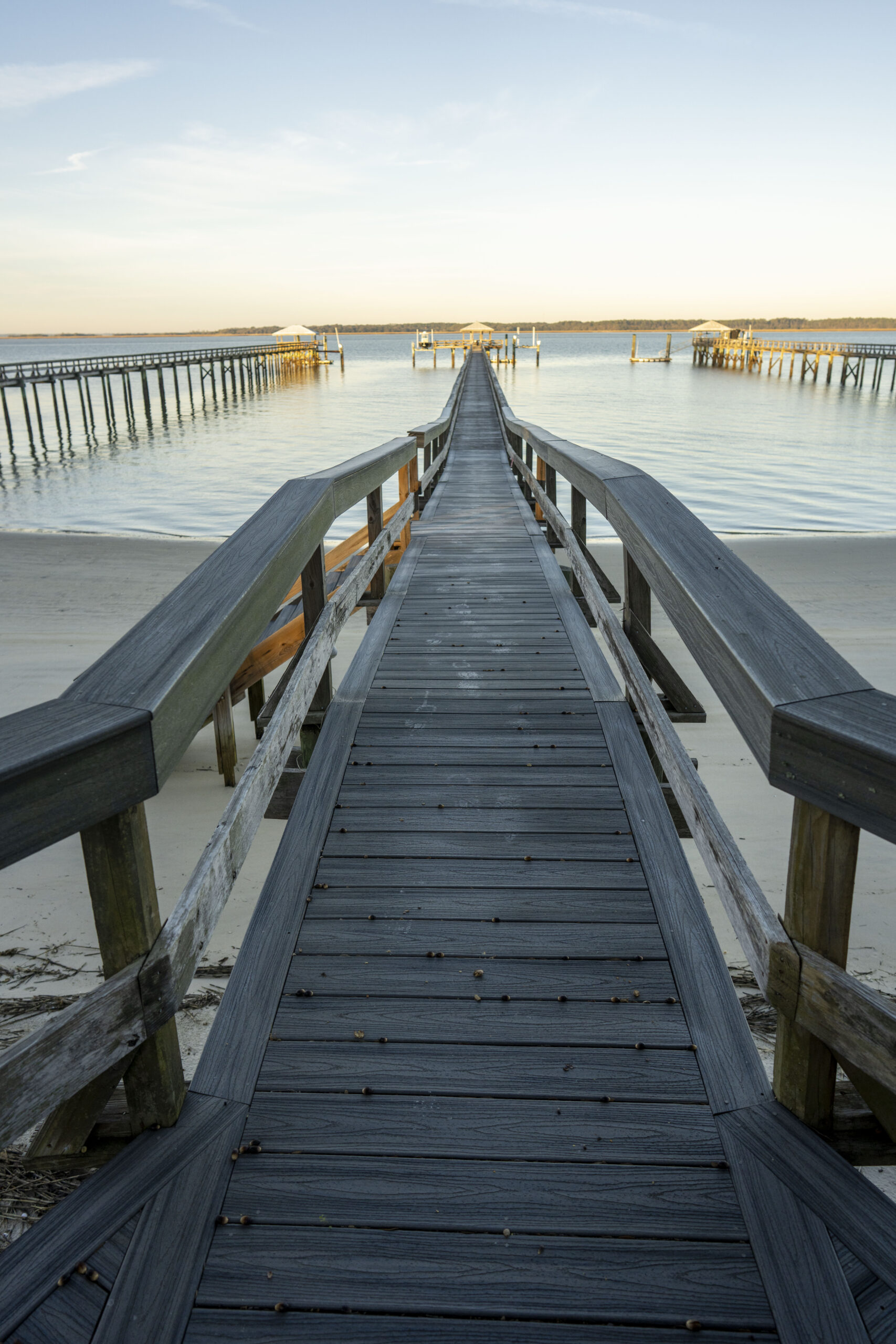
Definition: A pier is a raised, fixed structure built on vertical pilings or pillars that projects from the shoreline out over the water, with the water flowing freely underneath.
That gap between the decking and the waterline isn’t just aesthetic – it’s functional. Open water beneath the deck allows tidal movement, reduces sediment disturbance, and lets the structure reach deeper water without filling in the shallows. This is why piers are the standard choice for coastal areas with significant tidal change.
Piers typically run in a single finger configuration, projecting straight out from shore. The end platform – sometimes called an L-head or T-head – is where the action happens: boarding, fishing, or watching the sun drop into the water.
Key pier characteristics:
- Fixed structure – does not float or adjust to changing water levels
- Supported by driven pilings in wood, steel, or concrete
- Elevated above the water surface
- Designed to reach deeper water from a shallow shoreline
- Open water flow underneath the entire deck
Common uses include recreational fishing, public waterfront walkways, coastal access, and commercial passenger boarding for ferry or tour operations.
What Is a Dock?
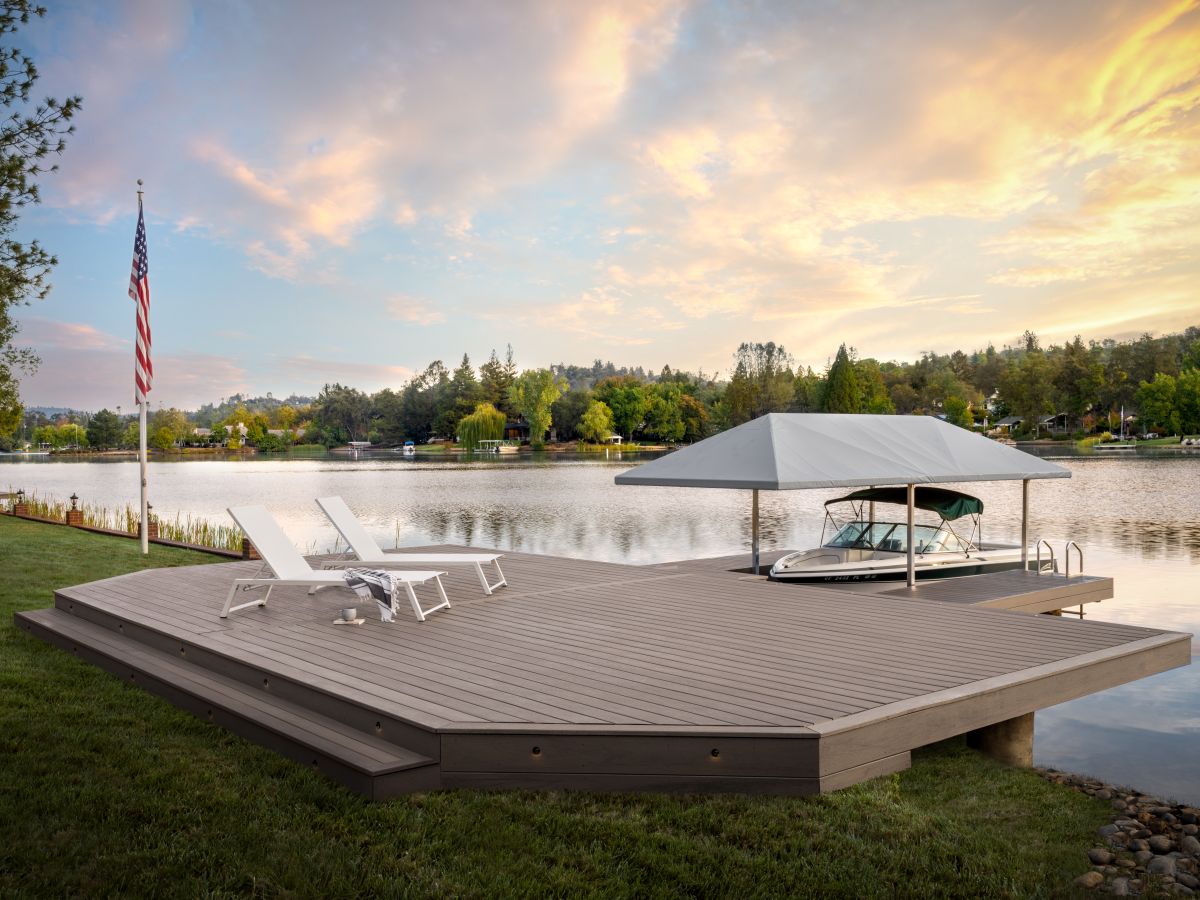
Definition: A dock is a structure – floating or fixed – positioned at or near water level, used primarily for mooring, boarding, and launching boats. If you want a deeper look at what a boat dock is and how it works, this section covers the essentials.
The operative word is mooring. Docks are built around the boat. Their shape, size, and placement are optimized for bringing a vessel alongside safely so you can step on and off, load gear, or hook up a water line. That’s why docks come in so many configurations: straight, L-shaped, T-shaped, U-shaped. Each layout solves a specific mooring problem.
Floating docks ride with the water. When the lake drops two feet in August, the dock drops with it. When spring flooding arrives, it rises. That adaptability is a major advantage in areas with significant seasonal water level variation – which covers most of the Great Lakes region, the upper Midwest, and countless inland lakes across the country.
Fixed docks sit at a permanent height, making them better suited to tidal environments where the range is predictable.
Docks are built around the boat – not to be confused with a deck, which stays on land. If you’re also wondering about the difference between a deck and a dock, that’s a separate comparison worth reading before you plan your waterfront build.
Key dock characteristics:
- Floating or fixed platform at or near water level
- Designed for boat mooring and boarding access
- Can be modular and seasonally removable
- Available in multiple configurations – L, T, U, straight
- Easier to DIY install than a pier
Piers vs Docks: Side-by-Side Comparison
| Feature | Pier | Dock |
|---|---|---|
| Structure type | Fixed, elevated on pilings | Floating or fixed at water level |
| Primary use | Recreation, fishing, access | Boat mooring and boarding |
| Water level adaptation | Does not adjust | Floating version adjusts automatically |
| Typical setting | Coastal, ocean, large lakes | Lakes, rivers, marinas |
| DIY installation | Difficult – requires equipment | Possible with modular floating systems |
| Average cost | $100,000+ for residential | $15,000 – $50,000+ depending on type |
| Permanence | Permanent structure | Can be seasonal and removable |
| Permits required | Yes – typically more complex | Yes – varies by jurisdiction |
| Shapes available | Linear (finger pier) | L, T, U, straight |
| Water flows underneath | Yes | No – floats on surface |
The Regional Language Problem Nobody Explains
Here’s where things get genuinely confusing – and where most articles on this topic fall flat.
In American English, “dock” and “pier” are used interchangeably by most lakefront homeowners, marina operators, and even some contractors. Ask someone in Minnesota what’s at the end of their property and they’ll say “dock” whether it’s floating foam sections or pressure-treated wood on driven pilings.
In British English, “dock” means something entirely different: an enclosed body of water used for commercial shipping. Think dry docks, port infrastructure, vessel repair yards. What Americans call a dock, the British call a jetty or a pontoon. A pier means roughly the same thing on both sides of the Atlantic – a structure extending over the water – but the functional context differs.
Canadian English sits somewhere between the two, drawing from both traditions depending on the region and the industry.
Within North America, there are regional quirks worth knowing:
- In the Great Lakes region, private floating structures on residential lakes are almost always called docks, never piers
- Along the Atlantic coast, “pier” typically refers to large public structures extending over the ocean (think Santa Monica or the historic piers of New Jersey)
- In the Pacific Northwest, “float” is commonly used for what the rest of the country would call a floating dock
Why this matters practically: If you’re buying property across regional lines or working with out-of-area contractors, nail down exactly what they mean. A “dock” in British maritime law is not the aluminum platform outside a lake cabin in Wisconsin.
The Permit Reality Nobody Talks About
Most pier vs dock articles tell you what each structure is. Few tell you what it actually takes to build one.
- Federal oversight: The U.S. Army Corps of Engineers (USACE) regulates any structure extending into navigable waters. That covers virtually all coastal projects and many inland waterways. A pier or dock on a navigable lake or river typically requires a Section 404 or Section 10 permit before a single piling goes into the ground.
- State permits: Every state layers its own environmental review on top. Virginia runs applications through the Virginia Marine Resources Commission. Florida manages coastal construction through the Department of Environmental Protection under the Coastal Construction Control Line (CCCL) program. Timelines vary from a few weeks to several years, depending on site sensitivity.
- Local zoning: Your county or city may impose setback requirements, maximum dock length limits, and HOA restrictions that operate completely independently of state and federal rules. Ignore them and you risk a removal order – at your expense.
- What permits cost: Expect to spend $1,000 to $5,000 on permit fees alone. That doesn’t include engineering drawings, environmental assessments, or consultant costs. Complex coastal projects can run significantly higher.
Here’s the permit detail that almost no competitor article mentions: because piers are permanent fixed structures requiring driven pilings, they face more regulatory scrutiny than floating docks. Many jurisdictions classify floating docks as temporary structures – which can mean lighter permit requirements and lower insurance costs. In some tight coastal markets, that distinction is the difference between a project that happens and one that doesn’t.
Real Cost Breakdown
Floating dock systems:
- Basic modular floating dock (DIY): $3,000 – $15,000
- Professionally installed floating dock: $15,000 – $30,000
- High-end system with boat lift: $30,000 – $50,000+
Fixed (piling) docks:
- Simple residential piling dock: $15,000 – $35,000
- Coastal or tidal fixed dock: $25,000 – $60,000+
Piers:
- Residential pier walkway: $125 – $300 per linear foot
- L-head or T-head platform at the end: $25 – $35 per square foot
- Full residential pier with permits and installation: $100,000 or more
The cost gap can be substantial. A floating dock system often comes in at less than half the cost of a comparable pier – and it typically requires fewer permits, less maintenance over time, and may receive more favorable treatment from homeowner’s insurance as a removable structure.
Materials move the needle significantly:
- Pressure-treated wood: lower upfront, higher long-term maintenance burden
- Composite decking: mid-range cost, dramatically lower maintenance
- Aluminum framing: higher upfront, excellent durability in salt and freshwater
- HDPE floating sections: resistant to UV, rot, and freeze-thaw cycles – the standard for quality modular systems
Materials: What Holds Up Over Time
- Wood is still common for fixed docks and piers. Pressure-treated lumber handles freshwater lakes reasonably well. Marine environments are another story – salt accelerates rot and corrosion in ways that surprise new coastal property owners. Plan for board replacement every 10–15 years and structural component replacement every 20–30.
- Aluminum is the choice of most quality residential dock manufacturers today. It’s lightweight, resists rust, handles saltwater corrosion, and survives freeze-thaw cycles without cracking. Aluminum dock sections can be disassembled and removed for winter storage, which extends their service life considerably.
- Composite materials – polymer-wood blends and full-polymer decking – have improved dramatically. High-density polyethylene (HDPE) is standard in many floating dock systems because it’s buoyant, impact-resistant, and requires no staining, sealing, or painting. It just needs occasional cleaning.
- Steel and concrete are the materials of commercial piers and wharves where heavy load capacity is the priority. They don’t make sense for residential applications.
Does a Pier or Dock Actually Add Property Value?
This is the question every competitor article avoids, and the answer is yes – but with conditions.
Market data from lakefront communities in Florida shows that homes with docks sell for approximately 21% more per square foot than comparable homes without them. On a million-dollar waterfront property, that’s a number worth paying attention to.
On average, a private dock increases resale value by $14,000 to $20,000. In high-demand waterfront markets where permits are scarce or deep-water access is limited, that range stretches much higher – sometimes into six figures.
A vacant waterfront lot in Virginia with a pier permit already in hand – not even the pier itself – can add $100,000 to the property’s value. That’s how complex and slow the permitting process can be in some coastal jurisdictions.
What drives dock and pier value at resale:
- Water depth: deep-water access commands a real premium
- Permit status: a legally permitted structure is worth far more than an unpermitted one
- Construction quality: buyers and appraisers recognize craftsmanship and it shows up in offers
- Accessories: boat lifts, covered platforms, and lighting increase appeal
- Regional market: in tight waterfront markets, dock access is often a deal-maker outright
One thing worth knowing before you build: a failing, aging, or unpermitted dock can actively reduce your property value rather than add to it. Buyers are increasingly sophisticated about waterfront structures. A pier they’ll need to replace before their first summer is a negotiating point against you.
Can You Have Both?
Yes – and in many waterfront configurations, it makes a lot of sense.
A pier might serve as the elevated scenic walkway reaching deeper water while a floating dock system along the shoreline handles practical mooring. Swimming platforms, fishing piers, and boat docks coexist on plenty of lakefront properties. Many setups in the upper Midwest combine a fixed pier with a lift dock or floating extension at the end.
The practical limits are usually your permit allowance – many jurisdictions cap total square footage of waterfront structures – and the physical layout of your shoreline.
Piers, Docks, Wharves, and Jetties: The Complete Picture
Since “wharf” and “jetty” come up in these comparisons:
- Pier: Fixed, elevated, recreational or light commercial, individual or public use
- Dock: Floating or fixed, boat mooring focus, residential or small commercial
- Wharf: Large, commercial-scale structure running parallel to shoreline, designed for cargo, ship traffic, and industrial operations – not a residential structure
- Jetty: A structure built perpendicular to shore to direct current or protect a harbor entrance – no walkway, no mooring function
Wharves belong in working ports with cranes and shipping containers. Jetties are engineering structures, not recreational ones. For anyone planning a residential waterfront project, neither term applies.
How to Choose: Pier or Dock?
Work through these questions:
What do you primarily need it for?
- Mooring and boarding boats = dock
- Fishing, swimming access, reaching deeper water from a shallow shore = pier or pier-style dock combination
What are your water conditions?
- Significant seasonal water level changes = floating dock, without question
- Stable water levels or predictable tidal environment = fixed dock or pier
What’s your budget?
- Under $30,000 = floating dock system
- $50,000+ budget, permanent installation = pier or fixed dock
What does your permit situation look like?
- Check with your local municipality and state DEP before you design anything
- Floating structures often face lighter requirements than permanent piers
What does the shoreline look like?
- Shallow shoreline needing to reach deeper water = pier is the better fit
- Adequate water depth already present = dock is sufficient
Are you planning to sell in the future?
- Both add value when properly permitted and well maintained
- Floating docks classified as removable may be simpler to address at sale
Five Things Other Articles Don’t Tell You
- The insurance distinction. Many homeowner’s insurance policies treat floating docks as removable personal property rather than permanent structures. That can mean lower premiums or no additional charge at all. A fixed pier is a permanent structure – expect it to show up on your coverage review and affect your rates.
- The HOA factor. Waterfront properties in planned communities may face dock and pier restrictions stricter than municipal codes. Some HOAs require specific materials, cap total dock length, or demand design committee approval before anything gets built. Check the CC&Rs before you hire a contractor.
- Environmental review timelines. If your shoreline borders wetlands, mangroves, or designated wildlife habitat, your permit process can stretch from months to years. In some coastal jurisdictions, new pier construction near sensitive habitat is heavily restricted or effectively blocked. This matters enormously if you’re buying a property with plans to build.
- Winter storage for floating docks. In northern climates, a floating dock that can be pulled and stored for winter lasts dramatically longer than one left in the water year-round. Ice damage is one of the leading causes of dock failure on inland lakes. Modular aluminum systems are specifically designed for seasonal removal – two people, no heavy equipment.
- The verb problem. When a boat “docks,” it ties up to a structure. That structure might be a pier, a wharf, or a floating dock – but the act of docking is the same regardless. This is partly how “dock” became the default word for all waterfront mooring structures in casual American usage, regardless of what the structure actually is.
Frequently Asked Questions
A pier is a fixed, elevated structure built on pilings with water flowing underneath. A dock is a platform – floating or fixed – at or near water level, designed for mooring boats. Piers prioritize access and recreation. Docks prioritize the boat.
Yes. Many residential piers include a mooring section at the end where boats tie up. A pier with an L-head or T-head platform functions as both a pier and a docking area. The terms overlap considerably in practice, which is part of why people use them interchangeably.
Piers are generally more expensive. A residential pier with professional installation and permits can exceed $100,000. A quality floating dock system typically runs $15,000 – $50,000 depending on size and add-ons.
Almost certainly yes. The U.S. Army Corps of Engineers requires permits for structures in navigable waters, and state agencies layer additional requirements on top. Even floating docks often trigger permit requirements depending on jurisdiction. Call your county permitting office and state environmental agency before you commit to any design.
Yes. Because piers are elevated on pilings, they can extend from a shallow shoreline out to navigable depth without disturbing the bottom or filling in the shallows. Floating docks need enough water to actually float – typically a minimum of three feet.
Both add value when properly permitted and well maintained. Market data from lakefront communities shows homes with docks sell for roughly 21% more per square foot than comparable properties without them. The permit status matters enormously – an unpermitted structure can create legal complications at closing and reduce rather than increase value.