
The place for all your outdoor living space!


Most deck problems don’t start with the decking boards. They start at the wall. The ledger board – the framing member that connects your deck to the house – is the most structurally loaded, most water-exposed, and most commonly mishandled connection in residential deck construction.
Deck ledger flashing is what protects that connection. Get it right, and the ledger connection lasts as long as the deck. Skip it or do it wrong, and water gets in, rot sets in quietly, and the connection fails – sometimes years before anyone notices.
The 2024 IRC took ledger flashing seriously for the first time. Here’s what changed, what the code now requires, and what a properly flashed ledger actually looks like.
What Is Deck Ledger Flashing and Why Does It Matter
The ledger board is a horizontal framing member bolted directly to the house’s band joist or rim joist. It carries half the deck’s load and transfers it into the house structure. Every joist on the deck either sits on or hangs from the ledger.
Definition: Deck ledger flashing is a layered moisture management system installed above, behind, and sometimes below the ledger board. Its job is to intercept water running down the wall, prevent it from getting behind the ledger, and redirect it away from the structural connection.
Flashing doesn’t just sit on top of the ledger. A proper ledger board flashing system integrates with the wall’s water resistive barrier (WRB) – the house wrap or building paper behind the siding – so water sheds outward rather than into the wall cavity.
Without flashing, every rain event sends water directly into the gap between the ledger and the house. The fastener holes, the cut face of the band joist, the end grain of the ledger – all of it sits in standing moisture until the wood gives out.
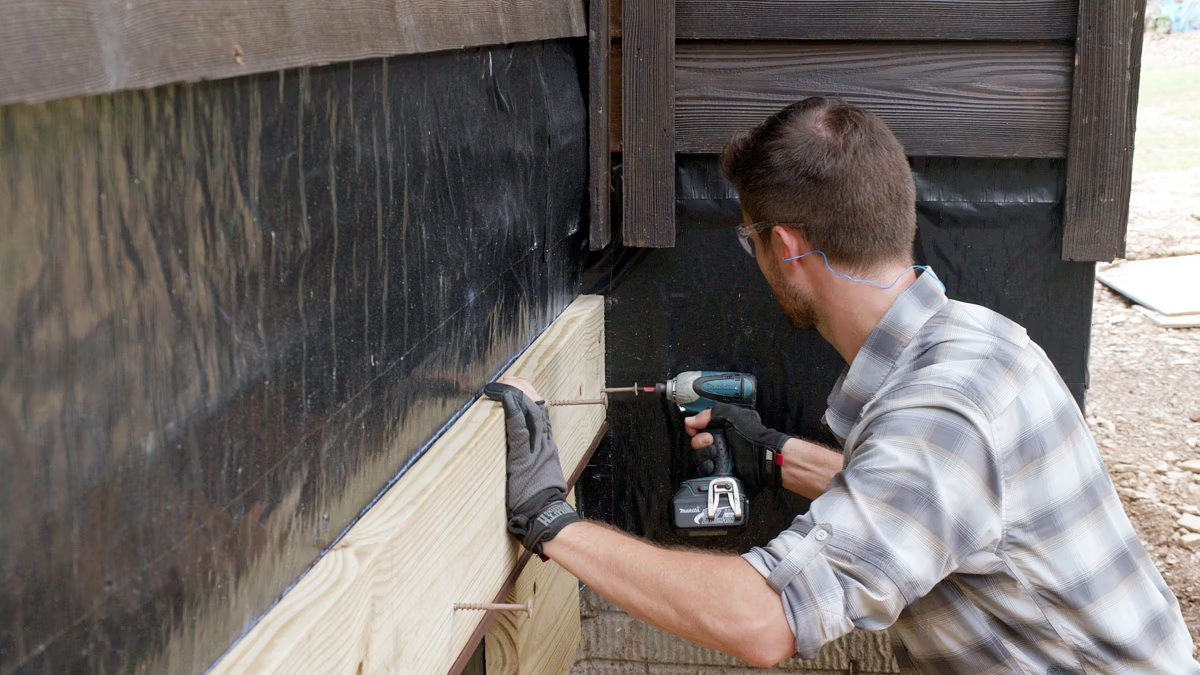
What Happens When Ledger Flashing Fails
Deck ledger rot doesn’t announce itself. It happens inside the wall, behind the siding, where nobody can see it. By the time there’s visible movement or bounce in the deck, the structural damage is often severe.
Deck collapse from ledger failure is well documented. The American Wood Council’s DCA 6 guide cites the ledger connection as one of the most common points of deck structural failure in the country. Failures have caused serious injuries and deaths at residential properties across multiple states.
The problem isn’t always a missing ledger board connection. Sometimes the ledger is properly bolted. The issue is that a properly bolted ledger still rots if it isn’t flashed – because the fastener holes themselves become water entry points, drawing moisture directly into the band joist.
What the 2024 IRC Now Requires for Ledger Flashing
The IRC has technically required deck ledger flashing since 2009. The 2015 edition added language requiring that decks “be flashed to prevent water from contacting the band joist.” But neither edition explained how.
That changed with the 2024 IRC. A new section, R507.9.1.5, gives prescriptive requirements for ledger flashing installation for the first time. This is what deck builders and inspectors have needed for years – specific, enforceable guidance rather than a vague flashing requirement buried in a footnote.
Section R507.9.1.5 requires flashing to be installed above the ledger, integrated with the WRB, and sized to extend at least 2 inches above the top of the ledger. All laps in the flashing system must overlap by a minimum of 2 inches, shingle-fashion, so water sheds down and away rather than into seams.
There’s also a new section worth knowing: R507.9.1.8 requires exterior wall coverings to terminate above the ledger board so the ledger can be fastened directly to the floor framing below. Previously, siding was often left in place behind the ledger – which compromised both the flashing and the structural connection. That’s no longer acceptable under the 2024 IRC deck code.
Flashing Materials the IRC Approves
Section R507.2.4 specifies what deck ledger flashing can be made from. The IRC allows corrosion-resistant metal at a minimum thickness of 0.019 inches, or approved nonmetallic materials that are compatible with both the wall substrate and the decking materials being installed.
In practice, this covers several common options:
| Flashing Material | IRC Approved | Best Use | Compatible with PT Lumber |
|---|---|---|---|
| Galvanized Steel | Yes – min 0.019″ | Drip cap, Z-flashing | Yes |
| Copper | Yes – min 0.019″ | Drip cap, step flashing | Yes |
| Aluminum | Yes – min 0.019″ | Drip cap, Z-flashing | No – must be separated with membrane |
| Self-Adhering Bitumen Membrane | Yes – approved nonmetallic | Back flashing, fastener sealing | Yes |
| Butyl Tape / Flashing Tape | Yes – approved nonmetallic | Seams, fastener holes, transitions | Yes |
| Z-Flashing (galvanized or vinyl) | Yes | Drip cap above ledger | Yes (galvanized) / Yes (vinyl) |
Aluminum flashing cannot come into direct contact with pressure treated lumber because the copper-based preservatives in the wood will corrode it. A layer of self-adhering membrane or flashing tape between the two materials solves this.
Self-adhering membrane products, often butyl or bitumen-based, are widely accepted as approved nonmetallic flashing. They bond directly to the sheathing, seal around fastener penetrations, and integrate cleanly with the WRB. Many experienced deck builders use peel-and-stick membrane as the primary back flashing layer behind the ledger and add a metal drip cap above it.
Z-flashing – named for its Z-shaped cross section – is a common choice for the drip cap above the ledger. It slides behind the WRB above and directs water out over the face of the ledger rather than behind it.
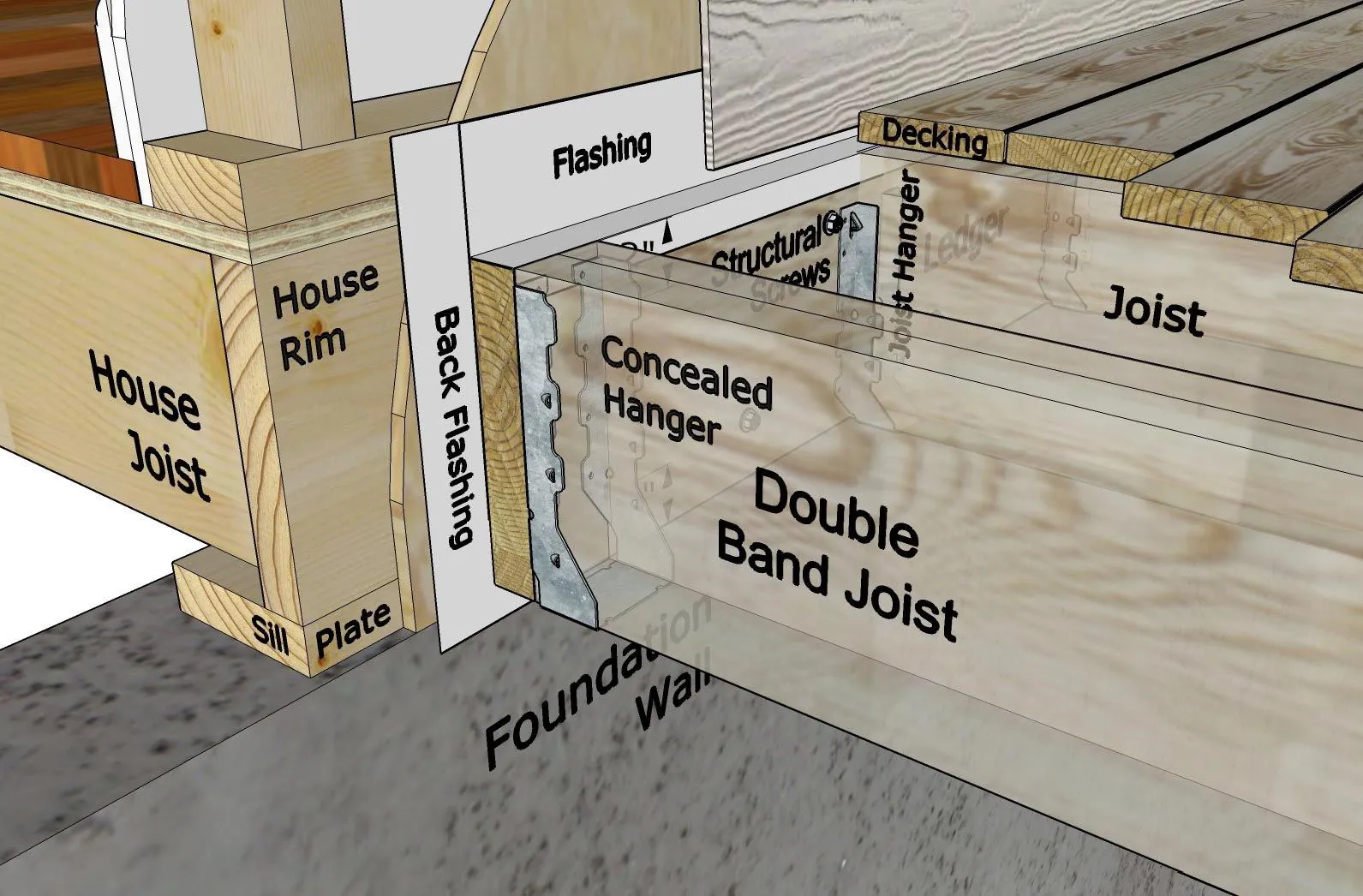
The Four Components of a Proper Ledger Flashing System
A ledger flashing system isn’t one piece of material. It’s a layered assembly. Each layer handles a specific part of the moisture problem.
Back Flashing and the Water Resistive Barrier
Back deck ledger flashing goes directly on the sheathing behind where the ledger will sit. It’s the first line of defense against water that finds its way through or around the ledger.
Self-adhering membrane is the standard choice here. A peel-and-stick butyl membrane applied to the sheathing before the ledger goes up does two things: it protects the sheathing itself from moisture, and it seals around the lag screws or through-bolts after they’re installed. Without back flashing, every fastener hole is an unprotected water entry point into the wall cavity.
The WRB – house wrap, building paper, or ZIP System tape on ZIP sheathing – integrates with the back flashing by lapping over it from above. This is the shingle-fashion lapping the 2024 IRC requires. Water hits the WRB, runs down to the back flashing, and sheds outward. Nothing gets behind the ledger.
Drip Cap and Bottom Flashing
The drip cap sits at the top of the ledger, behind the siding above and in front of the back flashing. Its job is to catch water running down the wall face and direct it outward, over the ledger and away from the house.
Z-flashing is the standard drip cap product for this application. It slides up under the siding above the ledger, laps over the back flashing below, and its lower leg sits on the face of the ledger. The 2024 IRC requires this flashing to extend at least 2 inches above the top of the ledger – which means it has to be sized correctly before the ledger goes in, not retrofitted after.
Bottom flashing, installed below the ledger board, catches water running down the ledger face and prevents it from wicking behind the siding below. Some builders skip this step, and it’s not always required by local code. In practice, adding it takes ten minutes and protects the siding course directly below the ledger from chronic moisture exposure. It’s worth doing.
Ledger Flashing on Remodels – What the 2024 IRC Says
Adding a deck to an existing home creates a specific challenge: the wall already has siding and sheathing in place, and it may or may not have a proper WRB behind the siding.
The 2024 IRC addresses this directly. On existing construction where no WRB is present behind the siding, one must be installed in the ledger area before the flashing is integrated. The siding also needs to be removed in the ledger zone so the flashing can be properly integrated with the wall assembly – not just slipped under the siding edge.
In practice, this means the ledger flashing installation on a remodel requires opening up the wall at least 6 inches above the ledger line. It adds time and labor. It’s also the only way to do it correctly, because surface-applied flashing that can’t integrate with the WRB doesn’t protect the band joist – it just redirects water to the next weak point.
There is one exception in the 2024 IRC for deck ledger flashing connections on existing construction: if the ledger is spaced off the wall by at least 1/4 inch, the flashing and lapping requirements are modified. A spaced ledger creates a drainage gap that allows water to escape rather than pool behind the board. This is a legitimate design approach, but it comes with its own structural requirements for the connection hardware and should be confirmed with the local building department before using it.
Common Ledger Flashing Mistakes Inspectors Catch
After years of inconsistent guidance, the 2024 IRC gave inspectors specific language to enforce. These are the most common ledger flashing failures they look for now.
| Mistake | What It Causes | How to Fix It |
|---|---|---|
| Flashing installed over the WRB instead of behind it | Water directed behind wall covering instead of away from it | Remove and reinstall – flashing must lap under WRB from above, shingle-fashion |
| Missing back flashing on sheathing | Fastener holes become unprotected water entry points | Apply self-adhering membrane to sheathing before ledger installation |
| Aluminum flashing direct contact with PT lumber | Copper preservatives corrode the aluminum – flashing fails prematurely | Separate with self-adhering membrane or switch to galvanized/copper flashing |
| No flashing on remodel – installed over existing siding | Water gets behind siding at ledger zone, rots band joist | Remove siding in ledger zone, install WRB if absent, then integrate flashing properly |
| Gaps and unsealed end dams at flashing corners | Water runs off flashing ends and behind siding | Fold end dams at each corner, seal all seams with compatible caulk or tape |
| Flashing not continuous along full ledger length | Water enters at interruption points | Run flashing continuously – no gaps, no seams without proper overlap |
Flashing installed over the WRB instead of behind it. This is the most common installation error. When flashing laps over the WRB instead of under it, water gets directed behind the wall covering instead of away from it. The whole point of shingle-fashion lapping is that water always sheds to the outside. Reverse that order and you’ve built a water funnel into the wall.
Missing or incomplete back flashing. Some builders apply a drip cap at the top of the ledger and consider the job done. Without back flashing on the sheathing behind the ledger, fastener penetrations are exposed and water can pool at the wall face of the ledger board for years before the damage becomes visible.
Aluminum flashing in direct contact with treated lumber. Copper-based preservatives corrode aluminum. A metal drip cap installed directly against a pressure treated ledger will fail faster than the ledger itself. Always separate the two materials with a self-adhering membrane or use a compatible flashing material.
No flashing on remodels. On existing homes, ledger flashing gets installed on top of the existing siding or skipped entirely because opening the wall feels like extra work. The 2024 IRC is clear: if there’s no WRB behind the siding in the ledger area, one needs to be installed before the ledger goes in. Inspectors in jurisdictions that have adopted the 2024 IRC are looking for this specifically.
Gaps and seams in the flashing assembly. Flashing that doesn’t run continuously along the full length of the ledger, or that has unsealed end dams at the corners, allows water to enter at the interruption points. End dams – small vertical folds at each end of the flashing – are required to prevent water from running off the ends of the drip cap and behind the siding.
Frequently Asked Questions
Deck ledger flashing is a layered moisture barrier system installed at the connection point between a deck and the house. It directs water away from the ledger board and band joist using a combination of back flashing, drip cap, and integration with the wall’s water resistive barrier. The 2024 IRC introduced the first prescriptive installation requirements for ledger board flashing in Section R507.9.1.5.
Yes. The 2024 IRC requires flashing above the ledger in new Section R507.9.1.5, with specific requirements for material, sizing, and integration with the WRB. The IRC has referenced ledger flashing since 2009, but the 2024 edition is the first to specify how it must be installed.
Section R507.2.4 allows corrosion-resistant metal at a minimum thickness of 0.019 inches, or approved nonmetallic materials compatible with the wall substrate and decking materials. Common approved options include galvanized steel, copper, self-adhering bitumen membrane, and Z-flashing products. Aluminum is acceptable but cannot be in direct contact with pressure treated lumber.
Back flashing is a layer of self-adhering membrane applied directly to the wall sheathing behind the ledger board before the ledger is installed. It protects the sheathing from moisture and seals around fastener penetrations. Without back flashing, lag screw and through-bolt holes become unprotected water entry points into the wall cavity.
Yes. Self-adhering membrane is one of the most effective materials for ledger flashing, particularly for back flashing on the sheathing behind the ledger. Butyl-based membranes bond directly to the sheathing, seal around fasteners, and integrate cleanly with the water resistive barrier. They meet the 2024 IRC’s approved nonmetallic material standard.
Water gets behind the ledger board and into the wall assembly. Over time, the band joist rots, the ledger fasteners lose their structural capacity, and the deck connection weakens. Deck collapse from ledger failure is one of the most documented structural failures in residential construction. A failed inspection is the best-case scenario – structural failure after the fact is far worse.