The place for all your outdoor living space!

Article Overview
- The Short Answer
- The Three Composite Decking Material Types
- Match The Material To The Deck, Not The Brand To The Budget
- Brand Comparison: What We Supply & Where Each One Fits
- Illinois Pricing: Representative Ranges (And How To Get A Real Number)
- The Mistakes That Cause Illinois Callbacks (And They Aren't About The Board)
- The "Zero Maintenance" Myth, Corrected For Illinois
- The One Piece Of Advice We Push Back On
- What An Accurate Quote Actually Needs From You
- So, Just Tell Me What To Buy
- Ready To Spec Your Deck The Right Way?
- Useful FAQs
- What is the best composite decking material for Illinois cold climate?
- Does composite decking crack or warp in freezing weather?
- What's the real difference between capped and uncapped composite?
- Is PVC or composite decking better for a deck in the Chicago area?
- How much does composite decking cost in Illinois?
- Which composite decking brands do you carry, and how do they differ?
Here is what most decking guides get wrong for our part of the country. They rank brands by price and prestige, then hand you a winner. But in Chicagoland, the brand name rarely decides whether a deck lasts. The environment does.
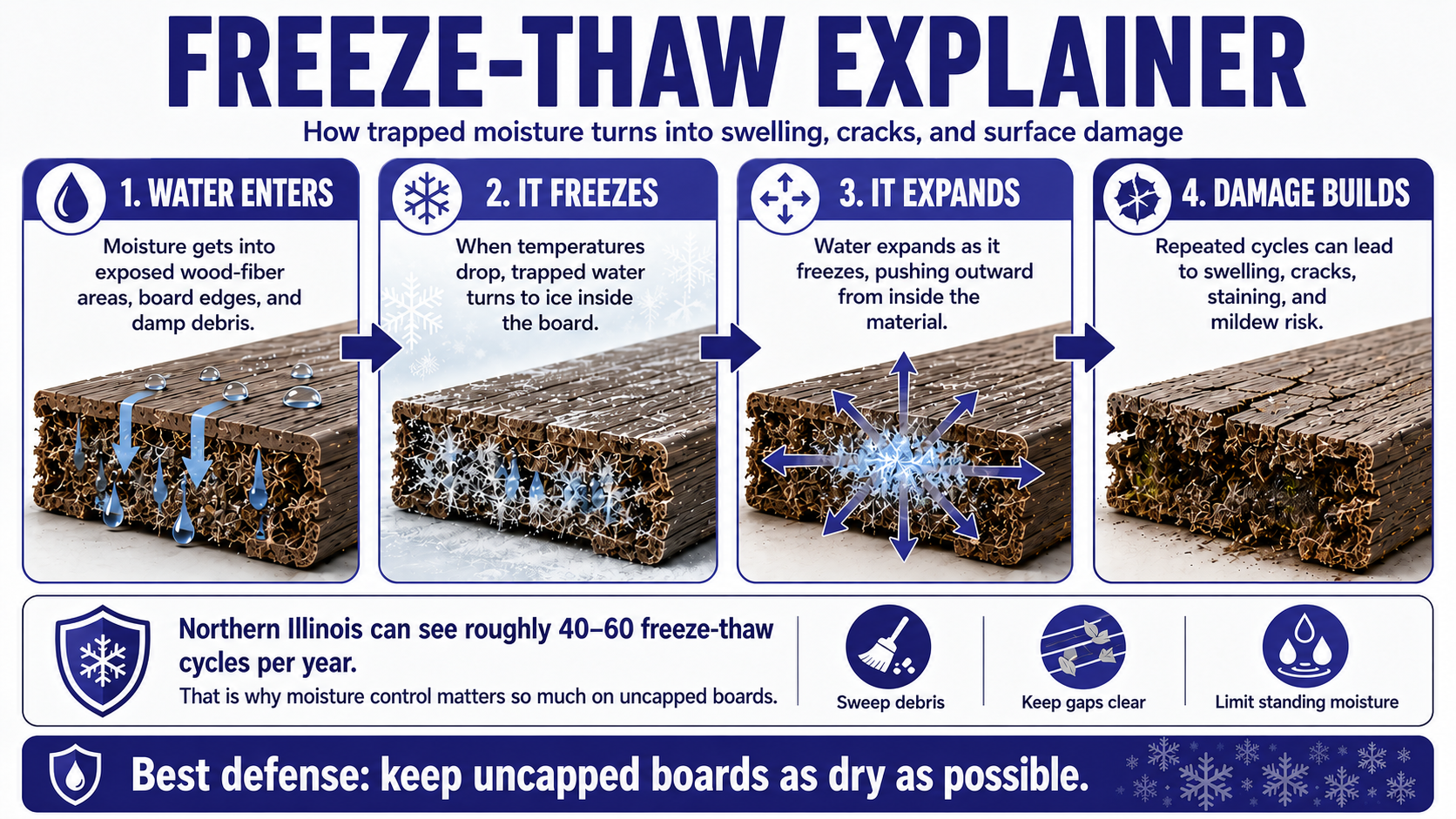
Freeze-thaw cycles, wet springs, and snow load are what actually break decks here. Northern Illinois runs through roughly 40 to 60 freeze-thaw cycles a year between the January lows and the summer highs. Every one of those cycles is water looking for a way into your boards. So the real question is not “which brand is best.” It is “which composite decking material fits this deck, in this spot, in this climate.”
We have answered that question across the counter since 2013, supplying the deck builders and homeowners who work across Illinois, Indiana, and Wisconsin. This guide is that conversation, written down, with more than ten brands under one roof and rough prices to plan around.
The Three Composite Decking Material Types
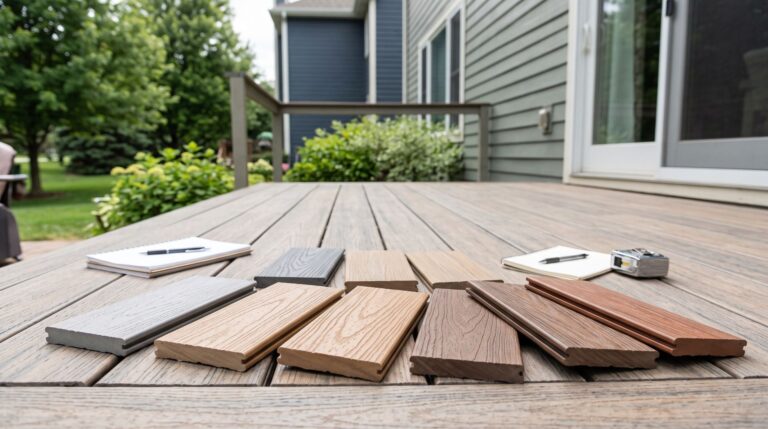
Before you compare brands, understand the three categories. Almost every board you will look at falls into one of them, and the category tells you more about winter performance than the logo does.
Capped Composite
Blends recycled wood fiber and plastic, then wraps it in a hard polymer shell called a cap. The wood-and-plastic core gives it a warm, natural look at a friendly price. The cap is the part that matters in Illinois: it seals out moisture, stains, and fading. Trex Select, TimberTech Terrain+, Fiberon Concordia, and Envision’s capped lines all live here.
PVC (Vinyl)
All polymer, with no wood fiber at all. That makes it the lightest and coolest option, and the best performer over water or under a covered roof. Wolf, Trex’s Signature PVC, and TimberTech’s Advanced PVC (Vintage, Landmark, Harvest+) sit in this group.
Mineral-Based Composite
Swaps the wood flour for mineral filler. Deckorators’ Surestone Technology uses a blend of polypropylene and calcium carbonate, which produces a dense board with virtually no water absorption. No organic fiber means freeze-thaw has nothing to work with. Voyage and Vault are even rated for ground and water contact.
One board deserves its own mention: MoistureShield. It is a wood composite, but its Solid Core boards are the only wood-plastic composite rated to install on the ground, in the ground, and even underwater. That makes it a real option for docks and low, damp spots where most wood composites struggle.
Here is the distinction we explain most often, and the one that decides the most jobs:
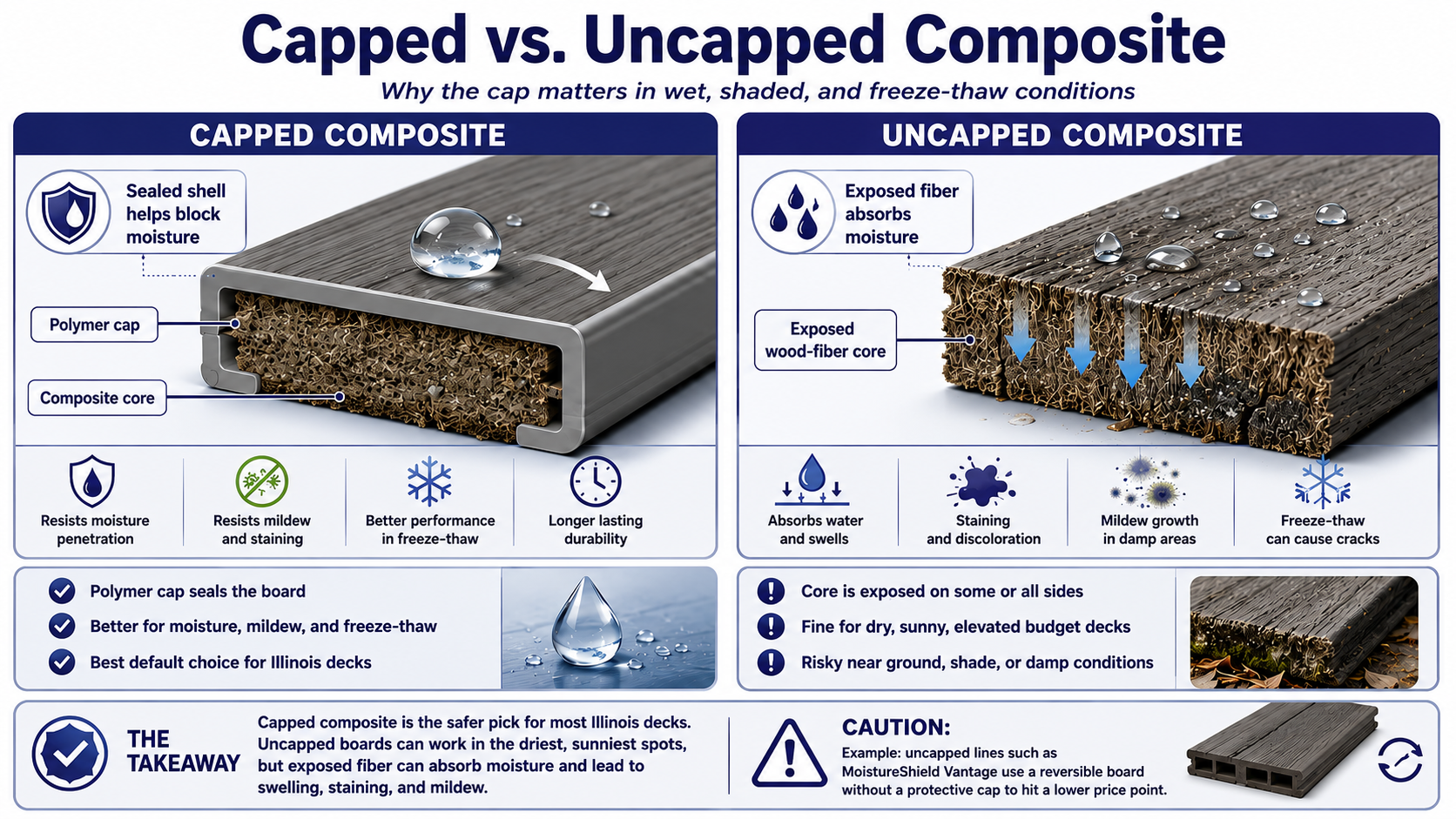
Capped vs. uncapped composite. The cap is a sealed shell around the board. Uncapped composite leaves the wood-fiber core exposed on some or all sides. In dry, sunny, elevated spots, uncapped can be a fine budget choice. Near the ground, in shade, or anywhere damp, that exposed fiber drinks moisture. Then freeze-thaw goes to work, and you get swelling, staining, and mildew. In Illinois, capped is non-negotiable except on the driest, sunniest decks. That caution applies squarely to the two uncapped boards we stock: MoistureShield Vantage, whose reversible boards skip the cap to hit a lower price, and Eva-Last Eva-Tech IS, an affordable uncapped bamboo composite.
Match The Material To The Deck, Not The Brand To The Budget
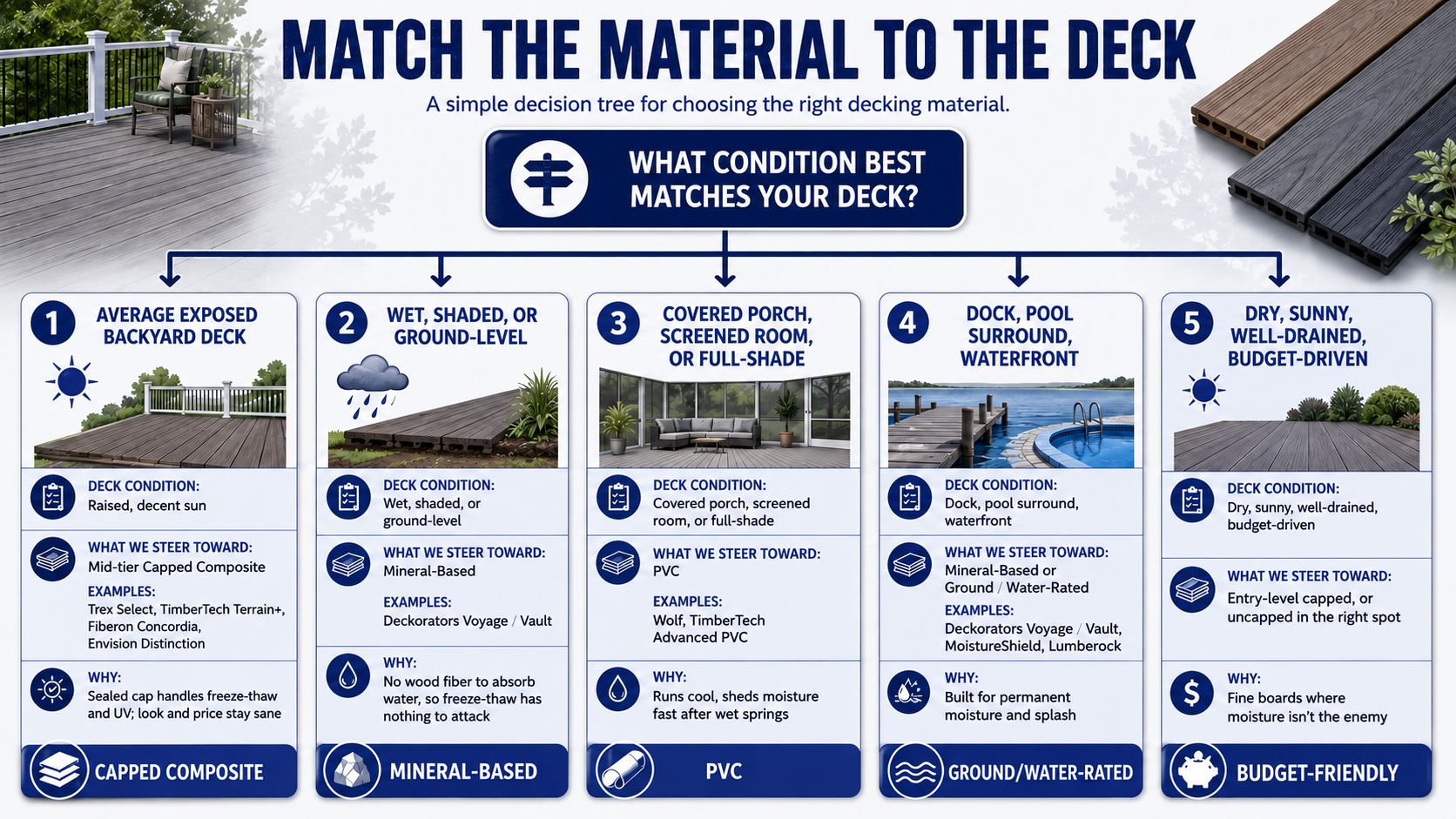
This is the part competitor articles skip. Same climate, different deck, different right answer. Here is how we actually route people.
| Your Deck Condition | What We Steer Toward | Why |
|---|---|---|
| Average exposed backyard deck, raised, decent sun | Mid-tier Capped Composite (Trex Select, TimberTech Terrain+, Fiberon Concordia, Envision Distinction) | Sealed cap handles freeze-thaw and UV; look and price stay sane |
| Wet, shaded, or ground-level | Mineral-Based (Deckorators Voyage/Vault) | No wood fiber to absorb water, so freeze-thaw has nothing to attack |
| Covered porch, screened room, or full-shade | PVC (Wolf, TimberTech Advanced PVC) | Runs cool, sheds moisture fast after wet springs |
| Dock, pool surround, waterfront | Mineral-Based or Ground/Water-Rated (Deckorators Voyage/Vault, MoistureShield, Lumberock) | Built for permanent moisture and splash |
| Dry, sunny, well-drained, budget-driven | Entry-level capped, or uncapped in the right spot | Fine boards where moisture isn’t the enemy |
Notice what is missing from that table: a single “best” board. There isn’t one. There is only the best board for the conditions in your backyard.
A Story From The Counter
A builder came in on a roughly 600-square-foot ground-level deck in the northwest suburbs. Shaded lot, poor drainage, sitting about a foot off grade. The homeowner was budget-driven and wanted uncapped composite to hit a low board price.
Two questions settled it: how low to grade, and how much sun. Both answers pointed the wrong way for uncapped. Low, damp, shaded.
We moved them to a mid-tier capped composite. A few dollars more per square foot bought a sealed shell against the moisture that lot was guaranteed to throw at it.
Why push back? Because on jobs where uncapped went down in that exact profile, we have seen the boards come back after two freeze-thaw seasons cupping, staining at the fasteners, and mildewing on the shaded runs. The savings got spent twice. (These figures are representative of the projects and pricing we see, not a single documented job.)
The waterfront version of this story is even simpler. A homeowner falls for a high-end wood-fiber composite because a neighbor’s deck looks great, then wants it on a dock. But the neighbor’s deck sits on a dry, elevated lot. On a dock in constant contact with water, wood fiber is the one place that board underperforms. That deck wants mineral-based, a ground/water-rated line like MoistureShield, or PVC. Every time. (If you are weighing a waterfront build, our guides on what a dock is and decks vs docks break down the material rules over water.)
Brand Comparison: What We Supply & Where Each One Fits
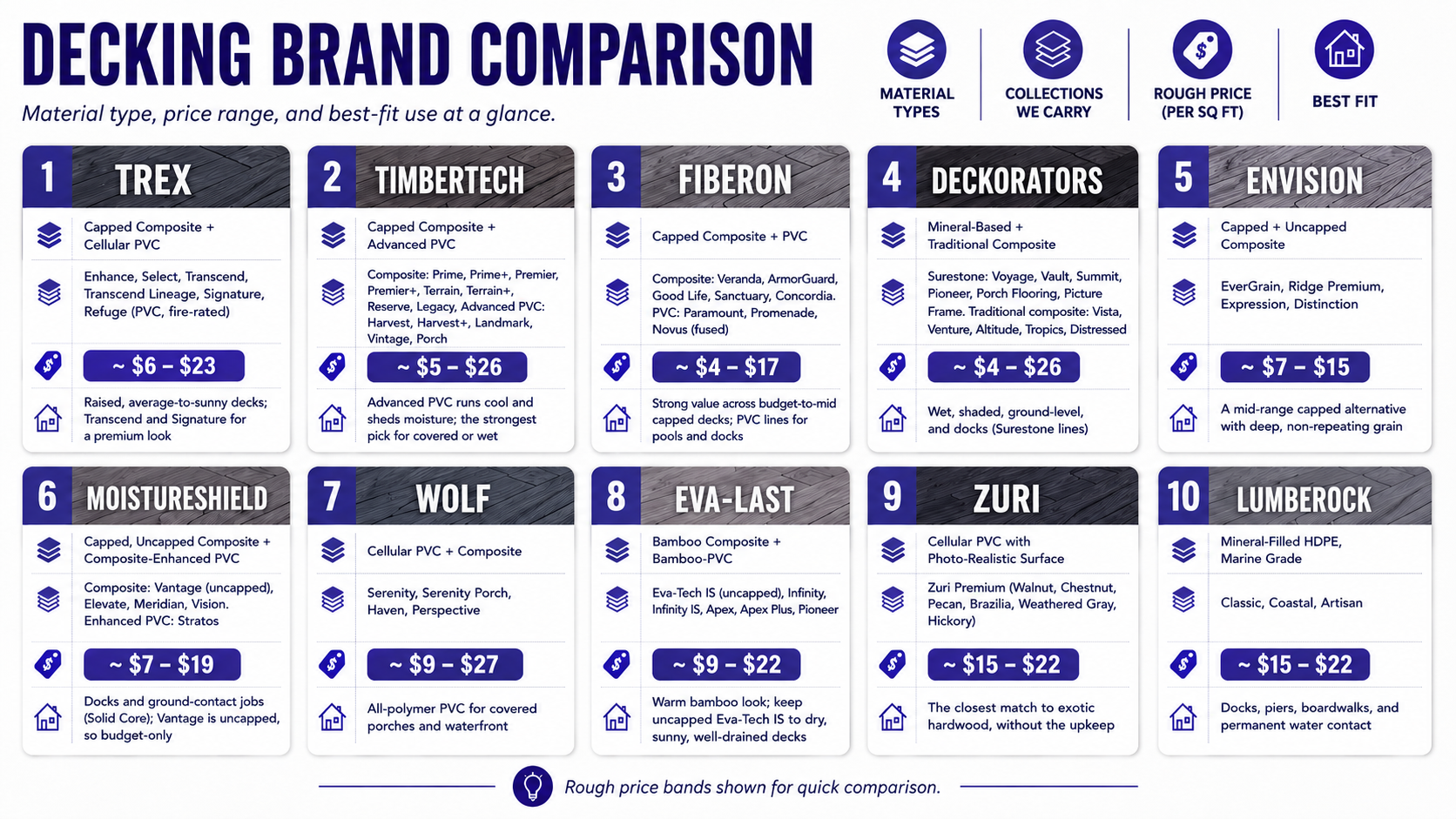
We carry more than ten decking brands across our two showrooms. Below are the eight most people compare, with rough board-only prices per square foot and the Illinois conditions each one suits best. For a wider brand-by-brand rundown, see our guide to the best composite decking brands. Prices are ballpark and move with color, length, and supply, so use them to plan, not to order.
| Brand | Material Types | Collections We Carry | Rough Board Price (Per SQ FT) | Where It Fits Best |
|---|---|---|---|---|
| Trex | Capped Composite + cellular PVC | Enhance, Select, Transcend, Transcend Lineage, Signature, Refuge (PVC, fire-rated) | ~ $6 – $23 | Raised, average-to-sunny decks; Transcend and Signature for a premium look |
| TimberTech | Capped Composite + Advanced PVC | Composite: Prime, Prime+, Premier, Premier+, Terrain, Terrain+, Reserve, Legacy. Advanced PVC: Harvest, Harvest+, Landmark, Vintage, Porch | ~ $5 – $26 | Advanced PVC runs cool and sheds moisture; the strongest pick for covered or wet |
| Fiberon | Capped Composite + PVC | Composite: Veranda, ArmorGuard, Good Life, Sanctuary, Concordia. PVC: Paramount, Promenade, Novus (fused) | ~ $4 – $17 | Strong value across budget-to-mid capped decks; PVC lines for pools and docks |
| Deckorators | Mineral-Based + Traditional Composite | Surestone: Voyage, Vault, Summit, Pioneer, Porch Flooring, Picture Frame. Traditional composite: Vista, Venture, Altitude, Tropics, Distressed | ~ $4 – $26 | Wet, shaded, ground-level, and docks (Surestone lines) |
| Envision | Capped + Uncapped Composite | EverGrain, Ridge Premium, Expression, Distinction | ~ $7 – $15 | A mid-range capped alternative with deep, non-repeating grain |
| MoistureShield | Capped, Uncapped Composite + Composite-Enhanced PVC | Composite: Vantage (uncapped), Elevate, Meridian, Vision. Enhanced PVC: Stratos | ~ $7 – $19 | Docks and ground-contact jobs (Solid Core); Vantage is uncapped, so budget-only |
| Wolf | Cellular PVC + Composite | Serenity, Serenity Porch, Haven, Perspective | ~ $9 – $27 | All-polymer PVC for covered porches and waterfront |
| Eva-Last | Bamboo Composite + bamboo-PVC | Bamboo composite: Eva-Tech IS (uncapped), Infinity, Infinity IS. Bamboo-PVC: Apex, Apex Plus, Pioneer | ~ $9 – $22 | Warm bamboo look; keep uncapped Eva-Tech IS to dry, sunny, well-drained decks |
| Zuri | Cellular PVC with Photo-Realistic Surface | Zuri Premium (Walnut, Chestnut, Pecan, Brazilia, Weathered Gray, Hickory) | ~ $15 – $22 | The closest match to exotic hardwood, without the upkeep |
| Lumberock | Mineral-Filled HDPE, Marine Grade | Classic, Coastal, Artisan | ~ $15 – $22 | Docks, piers, boardwalks, and permanent water contact |
A few notes on the newer names in that list. Envision is a capped + uncapped wood composite that competes in the entry-to-mid range, and its EverGrain and Ridge Premium lines are a sensible value pick for a straightforward raised deck. MoistureShield earns its spot for one reason: its Solid Core technology makes it the only wood composite rated to install on the ground, in the ground, or underwater, so it belongs in the dock and low-clearance conversation right next to Deckorators. Its capped Vision, Meridian, and Elevate lines also use CoolDeck coloring to cut surface heat, while the reversible Vantage board is the uncapped, budget option. Eva-Last is bamboo-based rather than wood-flour, spanning capped composite lines (Infinity, Infinity IS, Eva-Tech IS) and bamboo-PVC lines (Apex, Apex Plus, Pioneer), with a warm, distinctive grain. The entry-level Eva-Tech IS is best kept to lighter-duty, well-drained decks; step up to Infinity or the PVC lines for tougher, wetter spots. If you are weighing specific matchups, we have head-to-heads on Trex vs. Eva-Last and Trex vs. Lumberock.
Illinois Pricing: Representative Ranges (And How To Get A Real Number)
Across every brand and tier, board-only pricing runs from roughly $4 per square foot for a value board to about $27 for a top PVC or porch collection. Here is how that breaks down by material tier.
| Material tier | Example lines | Rough range (per sq ft, board only) |
|---|---|---|
| Entry-Level Capped Composite | Trex Enhance, TimberTech Prime/Premier, Fiberon Veranda/ArmorGuard, MoistureShield Vantage | ~ $4 – $8 |
| Mid-Tier Capped Composite | Trex Select, TimberTech Terrain+/Reserve, Fiberon Concordia, Envision Distinction, MoistureShield Meridian, Envision | ~ $9 – $17 |
| Mineral-Based | Deckorators Voyage, Vault, Vista | ~ $14 – $16 |
| Premium Composite | Trex Transcend/Signature, TimberTech Vintage, MoistureShield Stratos, Eva-Last | ~ $15 – $23 |
| PVC | Wolf Serenity, TimberTech Advanced PVC, Trex Signature, Zuri, Lumberock | ~ $9 – $27 (top and porch collections reach the high end) |
A professionally installed mid-tier deck in our region tends to land around $25 – 45 per square foot once you add frame, boards, and entry-level rail. A premium PVC build with upgraded rail will run higher than that. If you are tearing out an old deck first, our deck replacement cost breakdown covers demolition and disposal too.
Those bands are useful for planning. They are useless for ordering. For a real number tied to your actual deck, skip the guessing and use the free deck calculators. Pick your brand, enter your size and upgrades, and you get a full material list (boards, fascia, railing, substructure, stairs, fasteners, hardware) with quantities and projected cost, emailed to you to order or hand to your contractor. Want to dig deeper on price first? Our breakdown of what composite decking costs and our deck cost comparison by brand walk through the full picture, and how many decking boards you need explains the math behind the material list.
The Mistakes That Cause Illinois Callbacks (And They Aren’t About The Board)
You can pick the perfect board and still end up with a deck that looks wrong after one winter. Most of the failures we help builders avoid happen below the surface, at the planning stage, and the 2024 IRC code changes tightened several of them, from beam sizing to ledger flashing and stair rules. These are the mistakes that bite most often in our climate.
Diagonal Joist Spacing
People carry the 16-inch-on-center habit over from wood and assume it is universal. For most capped composite run straight, 16 inches is right. But the moment boards go diagonal, spacing has to tighten, often to 12 inches on center, and a lot of plans never account for it. Frame a diagonal composite layout at 16 inches and you get a soft, bouncy deck that no board upgrade can fix. The failure is already built in below.
Gapping At The Wrong Temperature
Composite and PVC move with the seasons, and Illinois hands them a brutal swing between a July afternoon and a January morning. Boards butted tight on a cold install day have nowhere to go when they expand in summer. The result: buckling, lifted seams, gaps that open unevenly after the first freeze. Every brand publishes its own gap numbers by install temperature, and that spec matters more here than almost anywhere. Our step-by-step guides on installing TimberTech and Fiberon decking walk through the gapping and fastener details line by line.
Then there is the substructure, which is where the most expensive mistakes live.
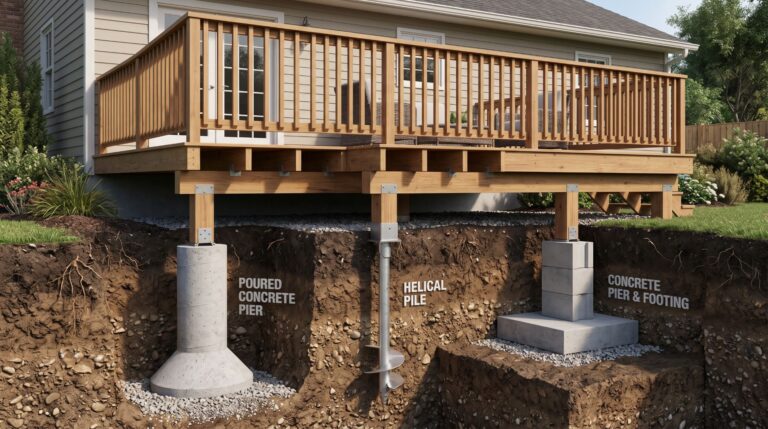
A quality board is a 25-to-50-year product. The frame under it often is not specified to match. Wet, freshly treated lumber that gets installed before it dries will twist, cup, and shrink as it dries out, and it drags a perfectly good composite surface out of plane with it. Every wave in the frame telegraphs up through the deck. On ground-level, damp, or long-span jobs, we push people toward properly dried lumber or a steel substructure, because wood movement is the real enemy. You cannot fix that mismatch without pulling the deck.
Two more that generate callbacks:
- Hidden fastener errors. Grooved-edge boards use clips that have to be seated to spec. Over-tighten them and you pinch out the expansion room the clip is designed to preserve. Mix in a fastener made for a different groove profile and you get squeaks and popped clips later. Systems change, too, so check the current spec (Trex, for one, updated its fastener guidance).
- Picture-frame and breaker-board details. A framed border needs an extra joist or blocking under it to fasten to. Long boards running into a breaker board need room to expand. A 20-foot run moves far more than a 8-foot one, and if the detail doesn’t leave room, the run pushes against the frame.
The warranty trap most people miss. A “50-year warranty” is rarely one blanket promise. Structural coverage and fade-and-stain coverage are usually separate terms with different lengths, and fade-and-stain is where real-world claims happen. Worse, the things that quietly void coverage (painting a board built not to be finished, ignoring the published gapping and spacing, using a non-approved fastener) are the exact install shortcuts above. So the same errors that cause the physical failure also erase the coverage that would have paid for it. Read the specific line’s warranty for both categories before you buy.
The “Zero Maintenance” Myth, Corrected For Illinois
“Zero maintenance” is marketing. The honest phrase is low maintenance. No sanding, staining, or sealing like wood. But not zero cleaning.
A composite or PVC deck here realistically needs a wash a couple of times a year, and the work is seasonal.
Spring is the real chore. Pollen, and especially those maple helicopter seeds, pile up in shaded, damp spots. Left sitting, that organic film feeds surface mildew. The board isn’t rotting; the grime on top of the cap is what grows the mildew. Soap, water, and a rinse clear it.
Winter salt is the part people ignore. Road salt tracked in from boots and driveways sits on the cap all season and can dull the finish. It won’t destroy a capped board, but letting it bake in for four months isn’t doing the surface any favors. Sweep it, and rinse during a thaw.
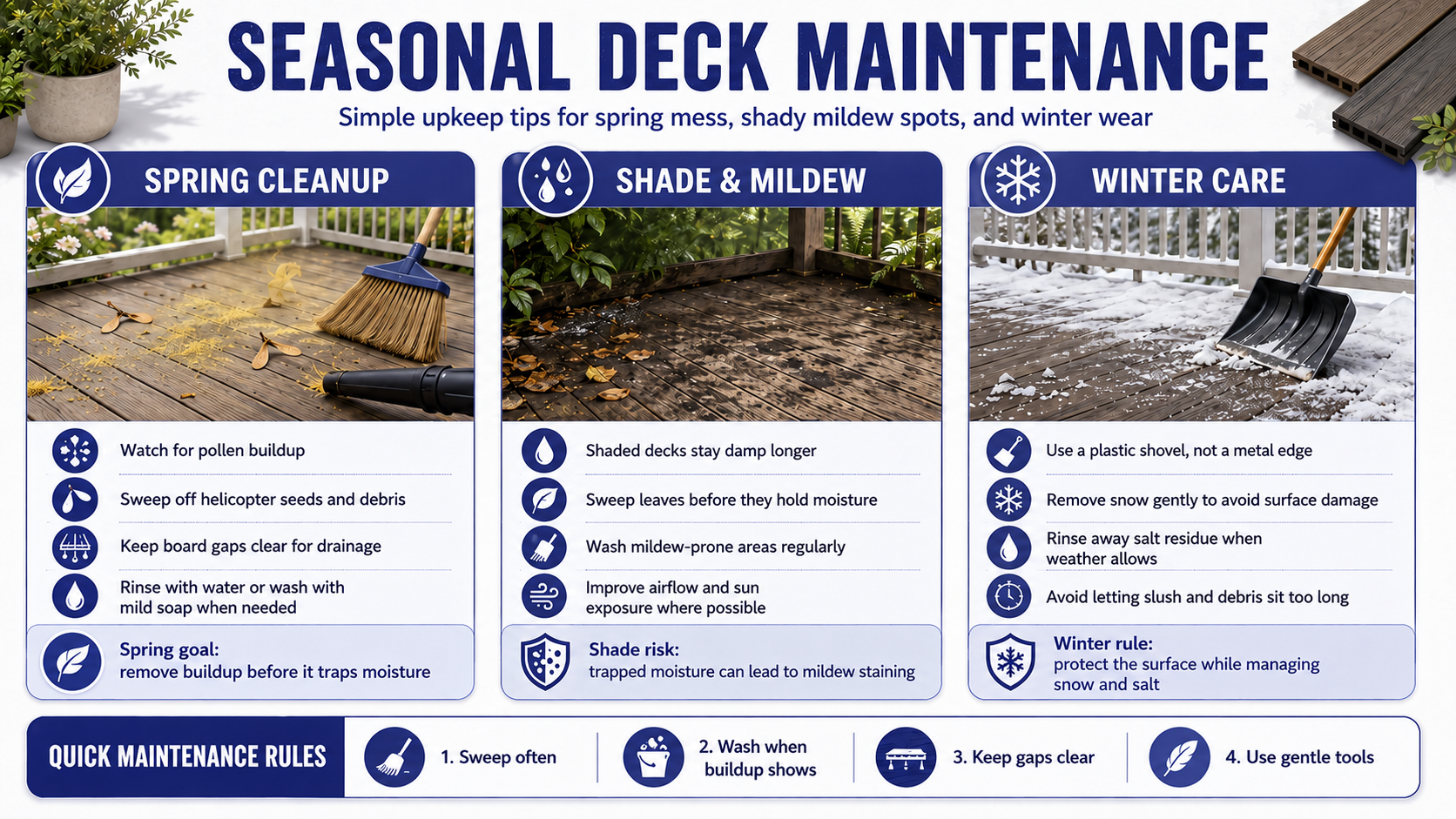
The mistakes we correct most:
- Metal snow shovels. A steel-edged shovel or ice chopper gouges the cap. Use a plastic shovel and push with the grain, and if winter traction is a concern, non-slip composite decking is worth reading before you pick a board.
- Harsh cleaners. Solvents, careless bleach, or a wire brush can damage the cap. Soap and water, or the manufacturer’s approved cleaner, is almost always enough, and the wrong product can void coverage. Start with our guide on cleaning composite decking, and we have brand-specific steps for TimberTech, Deckorators, and the rest of the lines we carry.
- Rock salt straight on the deck. Some ice melts are fine, some aren’t. Use one the manufacturer approves and rinse residue at the thaw.
- Pressure washing too hard. Too much pressure, too close, and you can etch the surface. Keep it low and at distance.
The One Piece Of Advice We Push Back On
You will read it in nearly every top article: “pick the lightest color to keep your deck cool.” The heat point is real. Darker boards do get hotter in the sun. Our guides on heat-resistant composite and PVC decking and whether composite decking gets hot cover that.
But as a blanket rule for Chicagoland, it steers people wrong. Heat is not our main enemy. Moisture, shade, and freeze-thaw are. A light-gray board on a shaded, damp, north-facing deck shows every bit of mildew film and grime, and it is the environment, not surface temperature, that drives most of the callbacks.
Color-for-temperature is a Sun Belt rule quietly copied into Midwest articles where it doesn’t fit. The real move here is to match the board and the color to the deck’s exposure. Damp and shaded? Prioritize a moisture-built board (Mineral-Based or PVC) and a tone that hides pollen and debris well. Save the light-color-for-heat logic for the genuinely hot, all-day-sun decks where it belongs.
What An Accurate Quote Actually Needs From You
The goal is one conversation instead of three. Show up with these, and we can quote real product and get you moving toward an order the same day.
- Square footage and a rough layout. Length by width, levels, stairs, and whether boards run straight or diagonal (diagonal changes joist spacing and adds waste).
- Substructure status. New frame, re-decking an existing frame, or ground-up. On a re-deck or full replacement, we need the existing joist spacing, because it dictates which boards will even pass.
- The environment. Sun exposure, how low to grade, and drainage. This is what moves you between capped composite, PVC, and mineral-based.
- Rail and lighting, decided early. Railing is a big line item with its own lead time, and lighting affects what gets wired before boards go down. For direction, browse our cable railing ideas.
- A color direction. Even “warm vs. gray, smooth vs. woodgrain” lets us quote real product. Don’t forget fascia, which finishes the perimeter and is easy to leave off a list.
- Delivery vs. pickup and a target install window.
Where people show up short: measurements from memory, not knowing existing joist spacing on a re-deck, or trying to match an old deck with no photo or line name (colors and profiles get discontinued, so we can’t confirm a match blind). Lead times surprise people too. Some lines ship in 24 – 48 hours; premium colors and matching rail can run longer.
Don’t Forget The Permit
Illinois changed the rules recently. As of January 1, 2025, Public Act 103-0510 requires every municipality in the state to enforce building standards at least as strict as the International Residential Code. Most towns now require a permit for a deck, with footings dug below the frost line (commonly 42 inches here) and a minimum 40-pound-per-square-foot live load. Deck framing, spacing, and rail rules follow IRC Section R507, and switching a wood-framed plan to composite carries its own rules, which we cover in what the 2024 IRC requires for composite decking. The permit itself is between you, your builder, and your village, but it shapes the substructure we spec, so settle it before the frame goes in.
So, Just Tell Me What To Buy
For a typical Chicagoland homeowner with an average exposed backyard deck: mid-tier capped composite. A Trex Select, a TimberTech Terrain+, a Fiberon, or an Envision board in that band. It is the sweet spot where the sealed cap handles our freeze-thaw and sun, the grain looks right, and the price stays reasonable. That is what we hand most people who want one answer.
Change the conditions and the answer changes with them. Wet, shaded, or sitting close to grade, we point people at Deckorators Voyage or Vault, the mineral-based boards that give freeze-thaw nothing to work with. Covered porches and anything over water go to Wolf Serenity or another all-polymer PVC. Docks and true ground contact belong to MoistureShield’s Solid Core lines, the only wood composite rated to sit on the ground, in the ground, or underwater.
The material target usually doesn’t change between a homeowner and a contractor. The reasons do. Homeowners weight look and warranty, so we spend more time on color and the fade-vs-structural terms. Contractors weight installability, consistency, and callback risk, so they will often move up a tier on a wet or ground-level job (into Deckorators mineral-based, a ground-rated MoistureShield line, or Wolf PVC), because they are the one who eats the callback if the wrong board goes down.
Same destination most of the time. Different reasons for getting there.

Useful FAQs
Capped composite is the right call for most Illinois decks, because the polymer shell blocks the moisture that freeze-thaw damage needs. For wet, shaded, or ground-level decks, mineral-based boards (like Deckorators Voyage or Vault) perform even better, since they have no wood fiber to absorb water at all. Uncapped composite is the one type to avoid except on dry, sunny, well-drained decks.
Quality capped and mineral-based boards hold up well because they resist the water absorption that causes cracking. The failures we see aren’t usually the board itself. They come from install mistakes: boards butted too tight on a cold day, or diagonal layouts framed at the wrong joist spacing. Follow the manufacturer’s gapping spec for your install temperature and most cold-weather problems never happen.
The cap is a hard polymer shell sealed around the board to keep out moisture, stains, and fading. Uncapped composite leaves the wood-fiber core exposed, which drinks water in damp or shaded spots and then swells and mildews through freeze-thaw. Uncapped can work on a dry, sunny, elevated deck. Near the ground or in shade, it is a false economy.
It depends on the deck. Capped composite gives you a warmer, wood-like look at a friendlier price and handles most raised, reasonably drained decks fine. PVC is all polymer, so it runs cooler and sheds moisture faster, which makes it the better pick for covered porches, screened rooms, and anywhere over water. Neither is universally “better.” The conditions decide.
Board-only pricing runs from about $4 per square foot for a value board up to roughly $27 for a top PVC or porch collection. Entry-level capped composite sits around $4 – $8, mid-tier around $9 – $17, mineral-based near $14 – $16, and PVC across a wide $9 – $27 span. A fully installed mid-tier deck typically lands near $25 – $45 per square foot with frame and entry-level rail. A deck calculator or a quote gives your real number.
We supply more than ten brands. Trex, TimberTech, Fiberon, Envision, and MoistureShield are wood-based capped composites, several with PVC lines too. Deckorators leads on mineral-based boards for wet and ground-level jobs. Wolf and TimberTech Advanced PVC cover the all-polymer end for cool, moisture-heavy spots. MoistureShield stands out for ground-and-water-contact ratings, and Eva-Last brings a bamboo-based option. The right one depends on your deck’s exposure, not the brand name.