The place for all your outdoor living space!

Article Overview
- Quick Answer
- How Composite Decking Differs From Wood Under the Code
- What the ASTM D7032 Label Must Show
- 12" vs 16" On Center – Why It Matters
- Diagonal Installation – When Spacing Changes Again
- What the Label Must Show for Stairs and Guards
- What is ASTM D7032 and does my composite decking need to meet it?
- What joist spacing does composite decking require under the 2024 IRC?
- Can composite decking be used for stair treads under the 2024 IRC?
- What is the fire rating requirement for composite deck boards?
- Is composite decking considered decay resistant under the 2024 IRC?
- How do I know if my composite decking product is code compliant?
Composite decking has taken a significant share of the residential deck market over the last decade. Low maintenance, good aesthetics, no splinters – contractors and homeowners both like it. What a lot of people don’t realize is that the composite decking code under the 2024 IRC now holds composite deck boards to a specific performance standard that didn’t used to be this clearly defined.
If you’re framing a deck for composite, or switching from wood to composite mid-project, this is what you need to know before the inspector shows up.
What the 2024 IRC Says About Composite Deck Boards
The 2024 IRC addresses composite decking in Section R507.2.2. The language is specific: all plastic composite exterior deck boards, stair treads, guards, and handrails must comply with ASTM D7032.
Definition: ASTM D7032 is the American Society for Testing and Materials standard that establishes performance ratings for wood-plastic composite (WPC) deck boards and guardrail systems. It covers structural performance, decay resistance, termite resistance where applicable, and fire performance. Think of it as the minimum bar a composite product has to clear before it’s code-recognized for exterior residential use.
Every product covered by the 2024 IRC must bear a label on the product or its packaging that shows compliance with ASTM D7032 and includes the allowable load and maximum allowable span determined under that standard. No label, no compliance.
How Composite Decking Differs From Wood Under the Code
Wood decking has been governed by prescriptive span tables for decades. A 5/4×6 deck board at 16 inches on center – that’s been standard long enough that most framers do it from memory.
Composite decking doesn’t work that way. Because wood-plastic composites vary significantly in their ratio of fiber to resin, their structural properties don’t follow the same rules as sawn lumber. Two composite products that look identical on the shelf may have completely different span ratings, load capacities, and required joist spacing. The only way to know what a specific product requires is to read the label and the manufacturer’s installation instructions.
That’s the fundamental difference under the 2024 IRC: wood framing follows code tables, composite decking follows the product’s rated performance. Those two things don’t always agree.
What Is ASTM D7032 and Why Does It Matter
ASTM D7032 is the standard the 2024 IRC uses to determine whether a composite decking product is code-compliant. A product either meets it or it doesn’t. There’s no in-between.
The standard covers several performance areas: structural capacity under load, deflection limits, resistance to decay for products containing biodegradable materials, termite resistance in applicable regions, and fire performance measured by flame spread index.
For deck builders, the most practically important outputs of ASTM D7032 testing are the span rating and the allowable load. These are the numbers printed on the label that tell you exactly how far apart your joists can be and how much weight the board can carry at that span.
What the ASTM D7032 Label Must Show
The 2024 IRC requires composite deck boards and stair treads to carry a label that includes two specific pieces of information: compliance with ASTM D7032 and the allowable load and maximum allowable span determined by testing.
For guards and handrails, the label must show compliance with ASTM D7032 and the maximum allowable span.
In practice, look for these on the product itself, the packaging, or the product’s ICC Evaluation Service report (ESR). Most major composite manufacturers publish their ESR reports publicly – if a product doesn’t have one, that’s a red flag worth investigating before it goes on the job site.
Composite Deck Joist Spacing – The Most Common Code Mistake
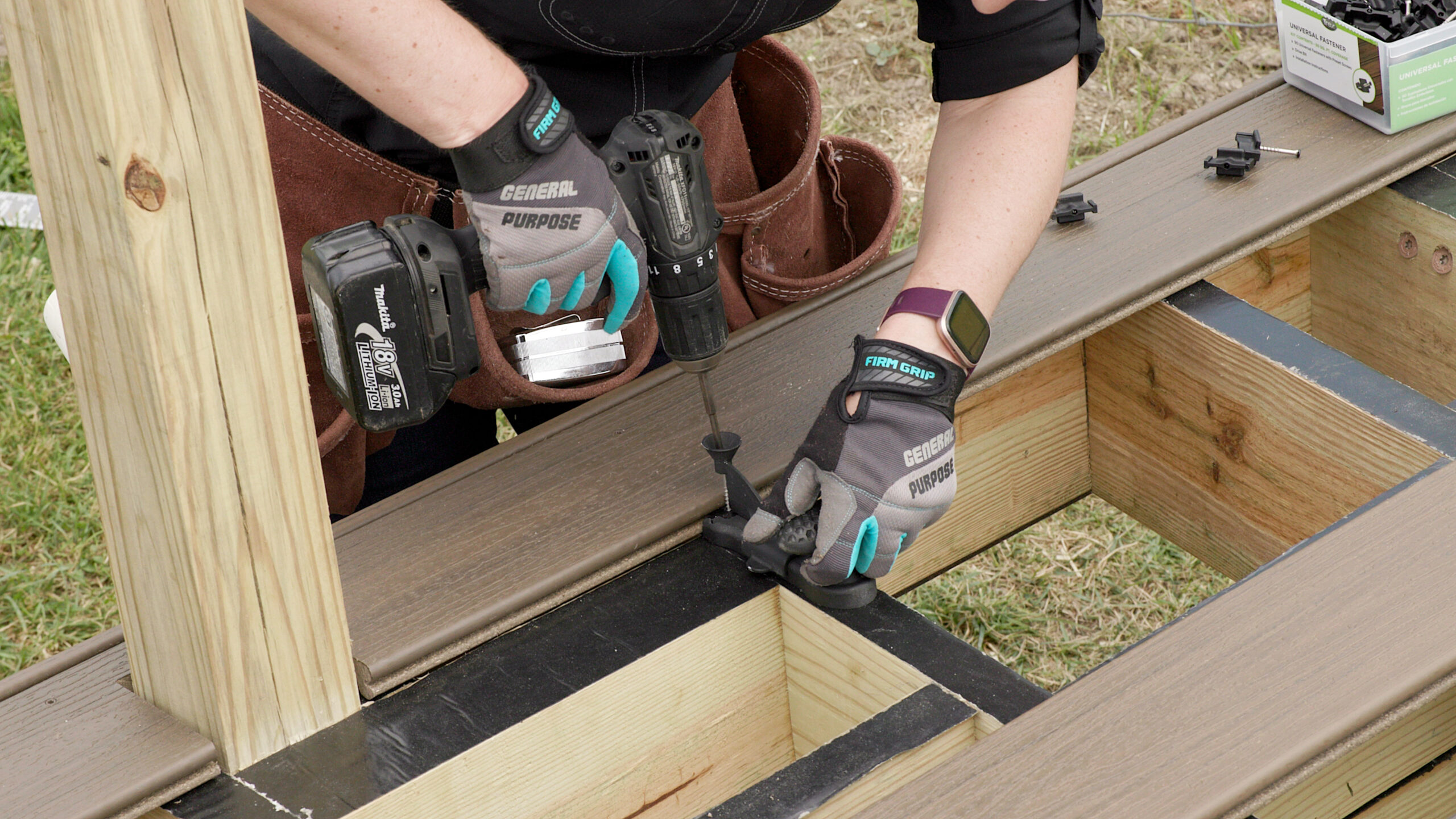
This is where the most inspection failures happen, and it’s almost always the same story: the framer spaced the joists at 16 inches on center because that’s what they always do for wood, and then the composite went down afterward.
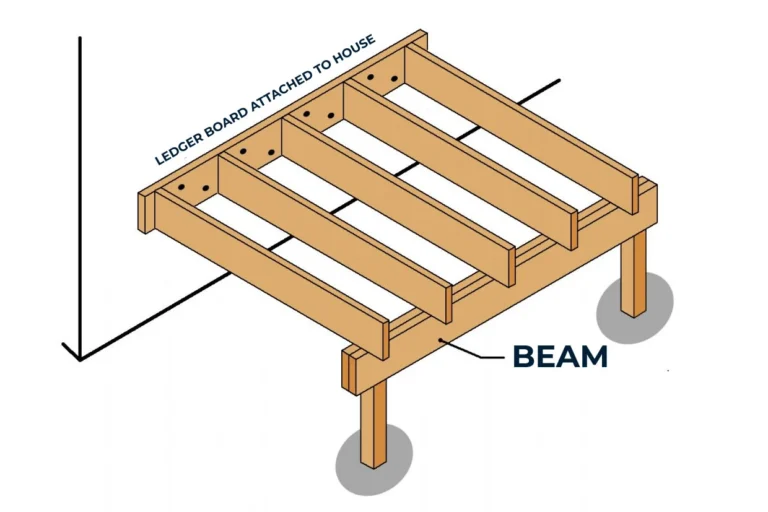
Some composite decking products are rated for 16 inches on center. Others require 12 inches. A few products – particularly thinner-profile boards – may require even closer spacing depending on their span rating. The only way to know is the product label.
12″ vs 16″ On Center – Why It Matters
At 12 inches on center, you’re adding roughly 33% more joists to the same deck frame. That’s more lumber, more labor, and more time. On a large deck, it’s a meaningful cost difference. Contractors who don’t know the composite product’s spacing requirement before they frame end up with two options: tear out the framing and redo it, or switch to a different product. Neither is a good outcome.
The 2024 IRC is clear: composite deck boards shall be installed in accordance with the code and the manufacturer’s instructions. If the manufacturer requires 12 inches on center and the framing is at 16, the installation is non-compliant regardless of how well everything else was done.
Diagonal Installation – When Spacing Changes Again
Installing composite boards at a diagonal angle to the joists – which a lot of homeowners like for visual interest – changes the effective span the board is crossing. A board running at 45 degrees to a 16-inch joist layout is effectively spanning a longer distance than one running perpendicular.
Most manufacturers address this in their installation instructions by requiring tighter joist spacing for diagonal installations – typically 12 inches on center when the standard composite decking code allows 16. Some products require blocking or additional support at specific intervals for diagonal runs.
Check the manufacturer’s instructions specifically for diagonal installation requirements. They’re often in a separate section and easy to miss.
Composite Decking Fire Rating Requirements
The 2024 IRC requires composite deck boards, stair treads, guards, and handrails to exhibit a flame spread index not exceeding 200 when tested under ASTM E84 or UL 723.
Definition: The flame spread index (FSI) measures how quickly fire moves across the surface of a material compared to red oak (FSI 100) and fiber cement (FSI 0). A maximum FSI of 200 means the material can spread flame up to twice as fast as red oak and still be code-compliant for exterior residential deck use.
There is one exception: plastic composite products determined to be noncombustible are exempt from the flame spread requirement. Most standard WPC products are combustible and need to meet the 200 FSI threshold.
For most deck builders, this doesn’t require any additional action. Major composite manufacturers test their products under ASTM E84 as part of the ASTM D7032 certification process, and the results are published in the product’s ESR. What it does mean is that composite products without ASTM D7032 certification – which covers fire performance – aren’t code-compliant under the 2024 IRC regardless of how they perform structurally.

Composite Deck Stair Treads, Guards and Handrails
Composite materials aren’t just for the deck surface. The 2024 IRC covers composite use for stair treads, guards, and handrails as well – and each has specific requirements under ASTM D7032.
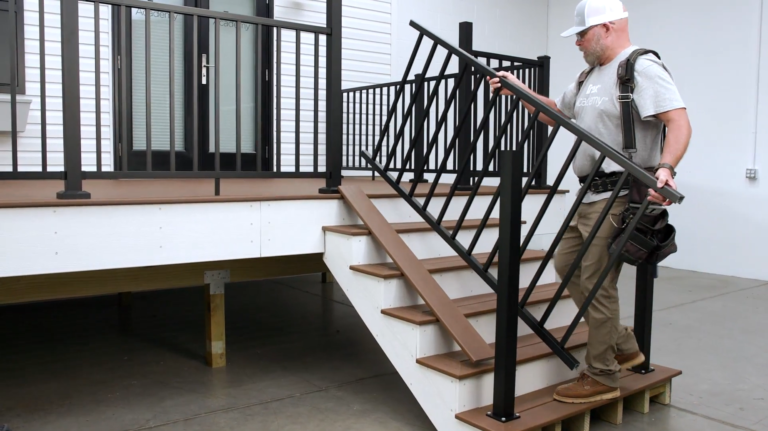
Composite stair treads must comply with the same ASTM D7032 standard as deck boards. Their packaging or labeling must show the allowable load and maximum allowable span under that standard. For stair tread applications, the standard also requires a minimum two-span condition – meaning the tread must bear on at least two supports, not just span between two stringers at the ends.
What the Label Must Show for Stairs and Guards
Composite guards and handrails have their own label requirement under the 2024 IRC. The label must indicate compliance with ASTM D7032 and the maximum allowable span for the guard or handrail system.
This matters because composite railing systems are sold in component kits, and not every component is rated for every span. A rail post spacing that works for a wood railing system may not be appropriate for a composite one. Always verify the specific span rating of the composite railing system being installed, not just the decking product.
For products containing wood, cellulosic, or other biodegradable materials, ASTM D7032 also requires the composite to meet decay resistance standards. In termite-prone regions designated under Section 305, the product must also meet ASTM D7032 termite resistance requirements. Both are typically part of standard ASTM D7032 certification for major manufacturers.
Composite vs Wood Decking – Which Is Easier to Keep Code Compliant
Wood decking has a simpler compliance path in one sense: prescriptive span tables in the IRC tell you exactly what’s allowed without needing to reference a product label. A 5/4×6 pressure treated board on 16-inch joists is covered by the code directly.
Composite decking puts more responsibility on the installer to know the specific product’s rated performance. The trade-off is that a compliant composite product sidesteps the treated wood and decay resistance debate entirely. Composite boards that meet ASTM D7032 are inherently decay resistant by definition of the standard – no need to verify sapwood content, treatment levels, or use categories.
From a long-term maintenance standpoint, composite decking also avoids the re-sealing, staining, and checking that pressure treated wood requires over time. For homeowners, that’s usually the deciding factor. For contractors, the compliance question comes down to one thing: know the product’s rated joist spacing before you frame. Everything else follows from that.
Common Composite Decking Code Mistakes Inspectors Catch
| Mistake | What It Causes | How to Fix It |
|---|---|---|
| Framing at 16″ o.c. for a product rated at 12″ | Deck boards exceed their rated span – automatic inspection failure | Verify joist spacing requirement before framing, not after |
| No ASTM D7032 label on product or packaging | Product can’t be verified as code-compliant | Use products with published ESR reports and visible labeling |
| Wrong joist spacing for diagonal installation | Boards span longer than their rated span at the diagonal angle | Check manufacturer instructions specifically for diagonal spacing |
| Composite guards installed beyond rated span | Guard system fails to meet load requirements | Verify span rating for the specific railing system, not just the decking |
| Missing blocking at stair tread applications | Single-span condition doesn’t meet ASTM D7032 two-span minimum | Ensure stair treads bear on at least two supports |
| Composite in contact with concrete or masonry without gap | Moisture trapping at contact point, accelerated wear | Follow manufacturer installation clearance requirements |
Frequently Asked Questions
ASTM D7032 is the performance standard for wood-plastic composite deck boards, stair treads, guards, and handrails. Under the 2024 IRC, all plastic composite products used in these applications must comply with ASTM D7032. Products must carry a label showing this compliance along with their allowable load and maximum allowable span.
It depends on the specific product. The 2024 IRC requires composite deck boards to be installed per the manufacturer’s instructions, which include the required joist spacing. Some products are rated for 16 inches on center. Others require 12 inches. Diagonal installations typically require tighter spacing than perpendicular ones. Always check the product label and installation instructions before framing.
Yes. Composite stair treads must comply with ASTM D7032 and their labeling must show the allowable load and maximum allowable span. The standard also requires a minimum two-span condition for stair tread applications – the tread must bear on at least two supports.
The 2024 IRC requires composite deck boards to exhibit a flame spread index no greater than 200 when tested under ASTM E84 or UL 723. Products that are noncombustible are exempt. Most major composite manufacturers test for fire performance as part of their ASTM D7032 certification – the results are published in the product’s ICC Evaluation Service report.
Composite products containing wood, cellulosic, or other biodegradable materials must meet ASTM D7032 decay resistance requirements. Products that pass ASTM D7032 testing are considered decay resistant under the 2024 IRC – no additional treatment is required. This is one of the practical advantages of composite decking over wood in jurisdictions where the treated wood requirements are creating compliance questions.
Look for an ASTM D7032 compliance label on the product or packaging showing the allowable load and maximum allowable span. Most major manufacturers also publish an ICC Evaluation Service (ESR) report for their products, which documents compliance with the 2024 IRC requirements. If a product doesn’t have an ESR report or a visible ASTM D7032 label, confirm compliance with the manufacturer before installation.