The place for all your outdoor living space!

Naming the brands is the easy part. Choosing between them is where projects go wrong, because warranty structure, board profile and fire rating separate these six far more than price does. Two of them will not even sell you a grooved board.
The PVC decking brands worth your money also changed more in the last twelve months than in the previous five years. Trex shipped its first all-plastic board. Wolf launched a new line. James Hardie bought the company behind TimberTech. Most articles ranking for this topic still describe a market that no longer exists.
That matters because PVC deck boards cost real money. You will pay 20 to 40 percent more than you would for capped composite, and you will live with that choice for decades. The brand you pick decides your warranty terms, your fastener options, your board lengths, and whether your deck passes inspection in a fire zone.
We carry every brand below. Come see samples side by side at either Chicagoland showroom, and we ship Trex nationwide.
What separates PVC decking from other deck boards
PVC decking contains 100 percent polyvinyl chloride and zero wood. No sawdust, no rice husk, no organic filler of any kind.
That single fact drives everything else. Mold needs organic material to feed on, so PVC deck boards starve it. Water has nothing to soak into, so the boards shrug off rain, splash and humidity. The trade-off comes as price and thermal movement, both of which run higher than capped composite.
Three build details separate good PVC decking boards from cheap ones:
- Cellular core versus solid core. Cellular cores trap tiny gas bubbles, which cuts weight and cost. Solid cores feel more substantial and resist dents better.
- Cap coverage. A four-sided cap wraps the top, bottom and both edges. A three-sided cap leaves the underside bare.
- Capstock chemistry. ASA and acrylic capstocks hold color under UV far better than plain PVC.
Two boards can look identical on a rack and carry warranties 25 years apart. Read the label, not the display.
The best PVC decking brands for 2026
Here is how the six brands compare on the specs that change your build.
| Brand and line | Core | Cap | Board size | Lengths | Profiles | Product warranty | Fade and stain | Fire rating | Best for |
|---|---|---|---|---|---|---|---|---|---|
| TimberTech Advanced PVC (Vintage, Landmark, Harvest+, Harvest, Solstice) | Cellular, ~60% recycled | 4-sided | 5.5″ x 1″ | Square 16′, 20′. Grooved 12′, 16′, 20′ | Grooved and square | Limited Lifetime | 50 years (Solstice 35) | Class A on Landmark and Vintage. Harvest+ meets WUI | Widest choice, best warranty |
| Wolf Serenity | High-Density Cellular | ASA COLORWATCH100 | 5.5″ x 1″, reversible | 12′, 16′, 20′ | Grooved and square | Limited Lifetime | 50 years | Not published | Value, coastal and wet sites |
| Wolf Haven | Cellular, scalloped | ASA COLORWATCH100 | 5.5″ x 1″ | 12′, 16′, 20′ | Grooved and square | Limited Lifetime | 35 years residential | Not published | Lowest entry price |
| Zuri by Westlake Royal | Cellular PVC substrate | Photo-real print under clear acrylic | 5.5″ nominal | 12′, 16′, 20′ | Grooved and square | See Westlake Royal terms | 25-year colorfastness | Not published | Exotic hardwood look |
| Trex Refuge | Cellular | 4-sided | 5.5″ x 1″ | 16′, 20′ | Square edge only | 50-year Limited Residential | Included in the 50-year term | Class A plus IWUIC ignition resistance | Fire zones |
| Fiberon Paramount / Promenade | Solid synthetic | 3-sided (Paramount), 4-sided (Promenade) | 0.99″ and 1.05″ x 5.5″ | 12′, 16′, 20′ | Grooved and square | Lifetime performance | 50 years | Class A plus CA SFM 12-7A-4 | Pools, docks, traction |
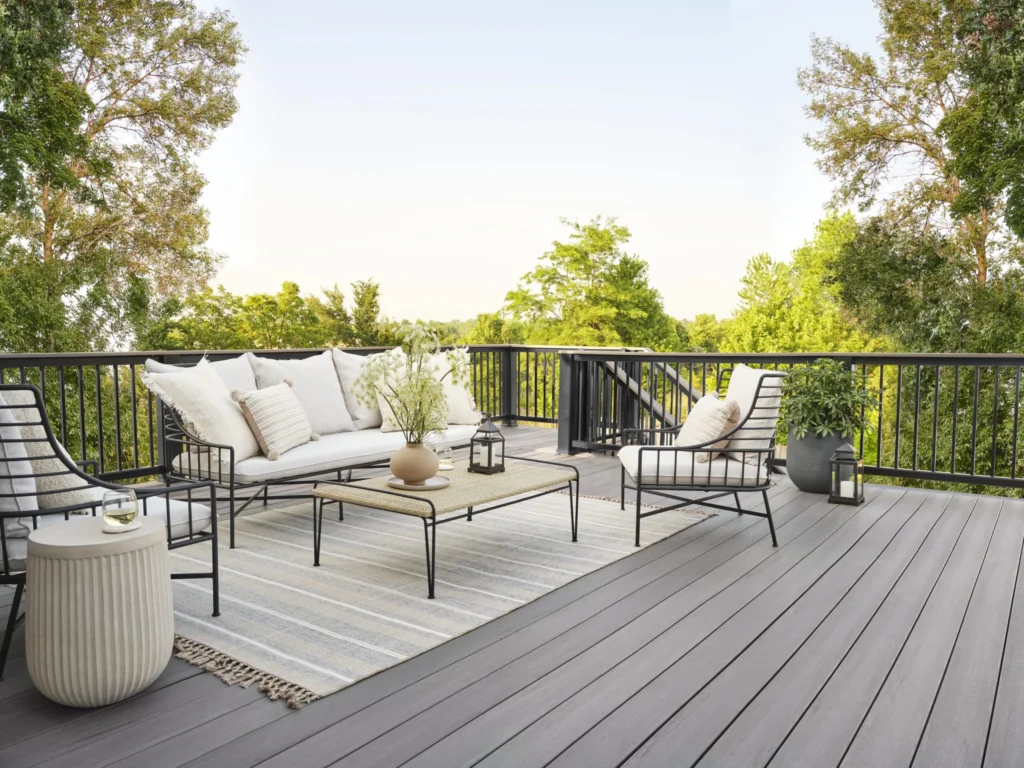
TimberTech puts more usable choice in front of you than any other brand here. Five collections cover the range: Vintage, Landmark, Harvest+, Harvest and Solstice. TimberTech makes them in the USA from roughly 60 percent recycled material, including reclaimed vinyl siding and trim.
The warranty leads the category. Every Advanced PVC collection carries a Limited Lifetime product warranty plus 50 years of fade and stain coverage, and Solstice carries 35 years on fade and stain.
Two collections earn a Class A flame spread rating and an Ignition Resistant designation: Landmark and Vintage. Harvest+ meets Wildland-Urban Interface requirements. Check the collection, not the brand name, because the ratings do not apply across the whole line.
One spec nobody else publishes: Harvest MAX in Slate Gray runs half an inch thicker than a standard Harvest board. That extra thickness lets it span joists at 24 inches on center, which suits docks and boardwalks.
The boards also heat-bend, so a curved bench face or a rounded stair nosing stays on the table.
Watch for: James Hardie completed its acquisition of The AZEK Company on 1 July 2025. TimberTech and AZEK now sit inside the James Hardie portfolio. Product lines, warranties and support carried over intact, but you will see the older AZEK branding on plenty of dealer listings and older articles.
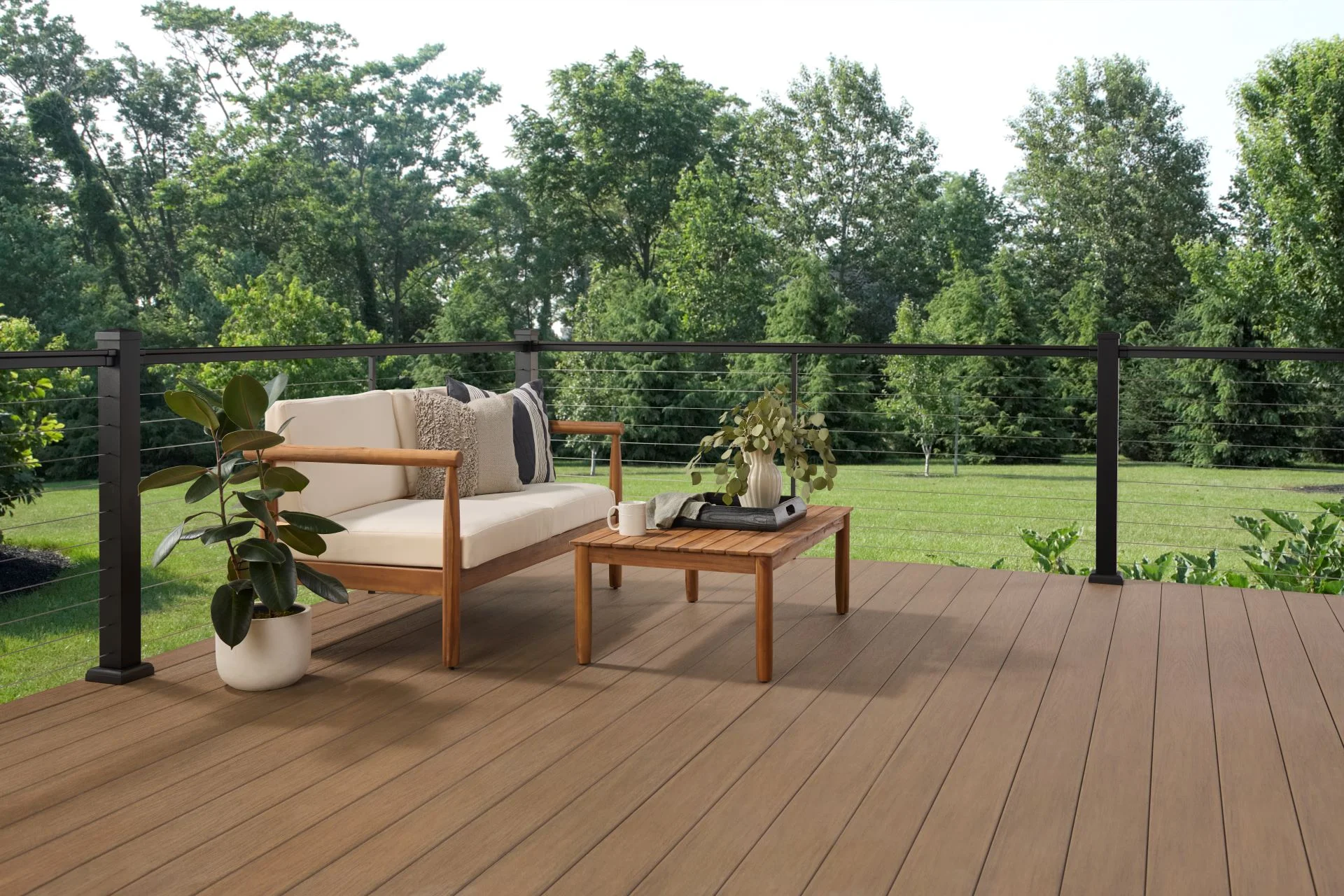
Wolf Serenity delivers the strongest warranty-per-dollar ratio of any board on this list. Wolf backs it with a 50-Year Stain and Fade Warranty and a Limited Lifetime product warranty, and prices it well below the premium collections.
The board pairs a High-Density Cellular core with a premium ASA capstock that Wolf calls COLORWATCH100. ASA resists UV better than standard PVC formulations, which keeps dark colors dark.
Serenity also carries an ICC-ES evaluation report, ESR-2824. Very few decking products publish one, and inspectors respect it.
Practical details matter here. The boards run reversible at 1 inch by 5½ inches in 12, 16 and 20 foot lengths, and Wolf supplies matching ½ inch by 11¾ inch rimboard. You can order grooved for hidden fasteners or square edge for face screws.
Two collections cover the color range. Tropical Hardwoods brings variegated wood tones. Seaside offers cool, solid coastal shades.
Best fit: rain, humidity, pool surrounds and docks. Wolf built this board for wet climates and it shows.
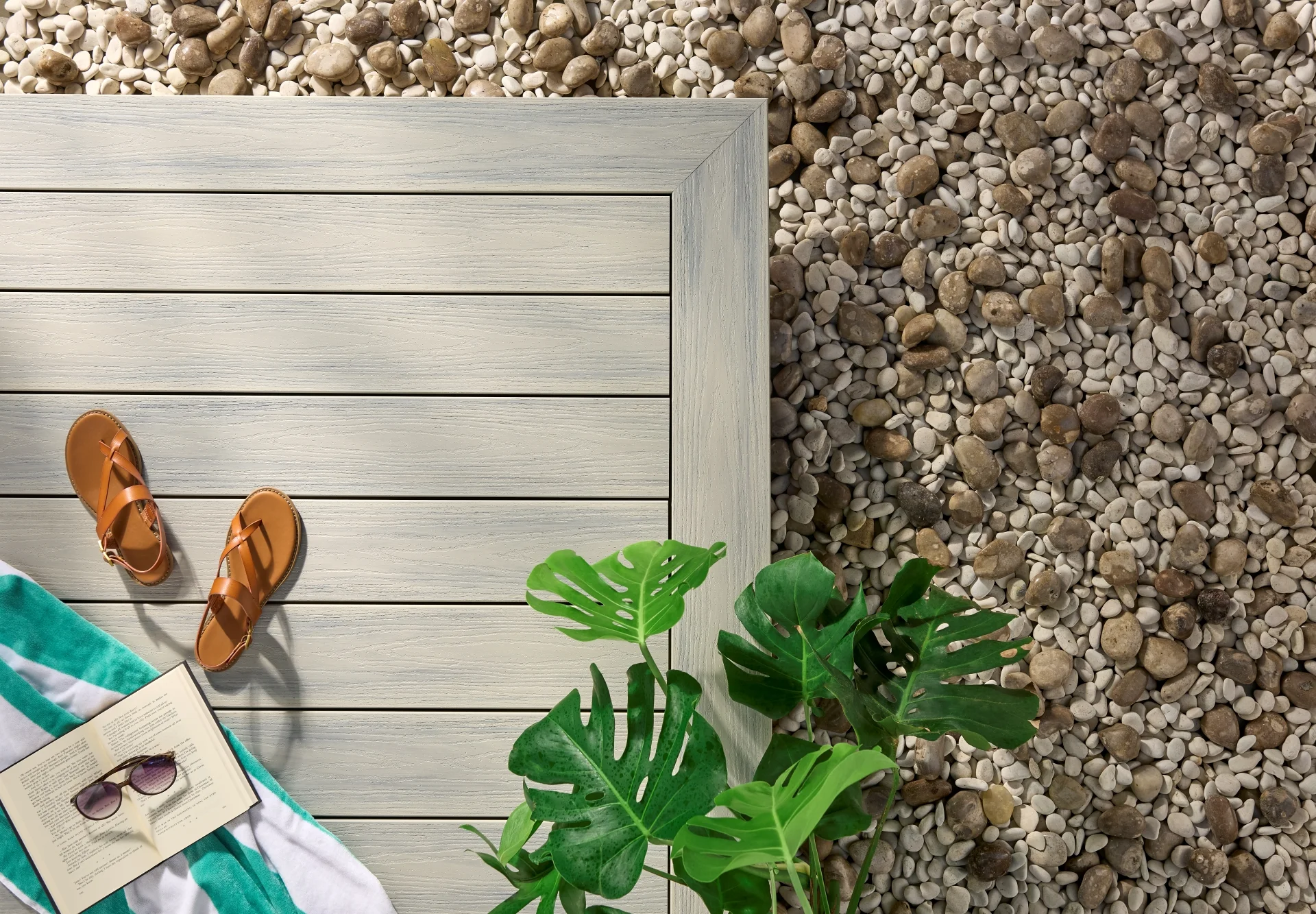
Wolf launched Haven on 26 January 2026, which makes it the freshest product in this comparison. The Homestead Collection anchors it, with heritage colors and real-wood texture aimed at farmhouse and rustic builds.
Haven uses a scalloped profile instead of a solid one. Scalloping removes material from the underside, so the board weighs less, costs less and installs faster. You give up some rigidity in exchange, which matters on stair treads and under heavy furniture.
Wolf caps Haven with the same ASA COLORWATCH100 technology it uses on Serenity. The warranty steps down to 35 years residential alongside a Limited Lifetime product warranty.
Best fit: homeowners who want genuine PVC performance at a composite price point.
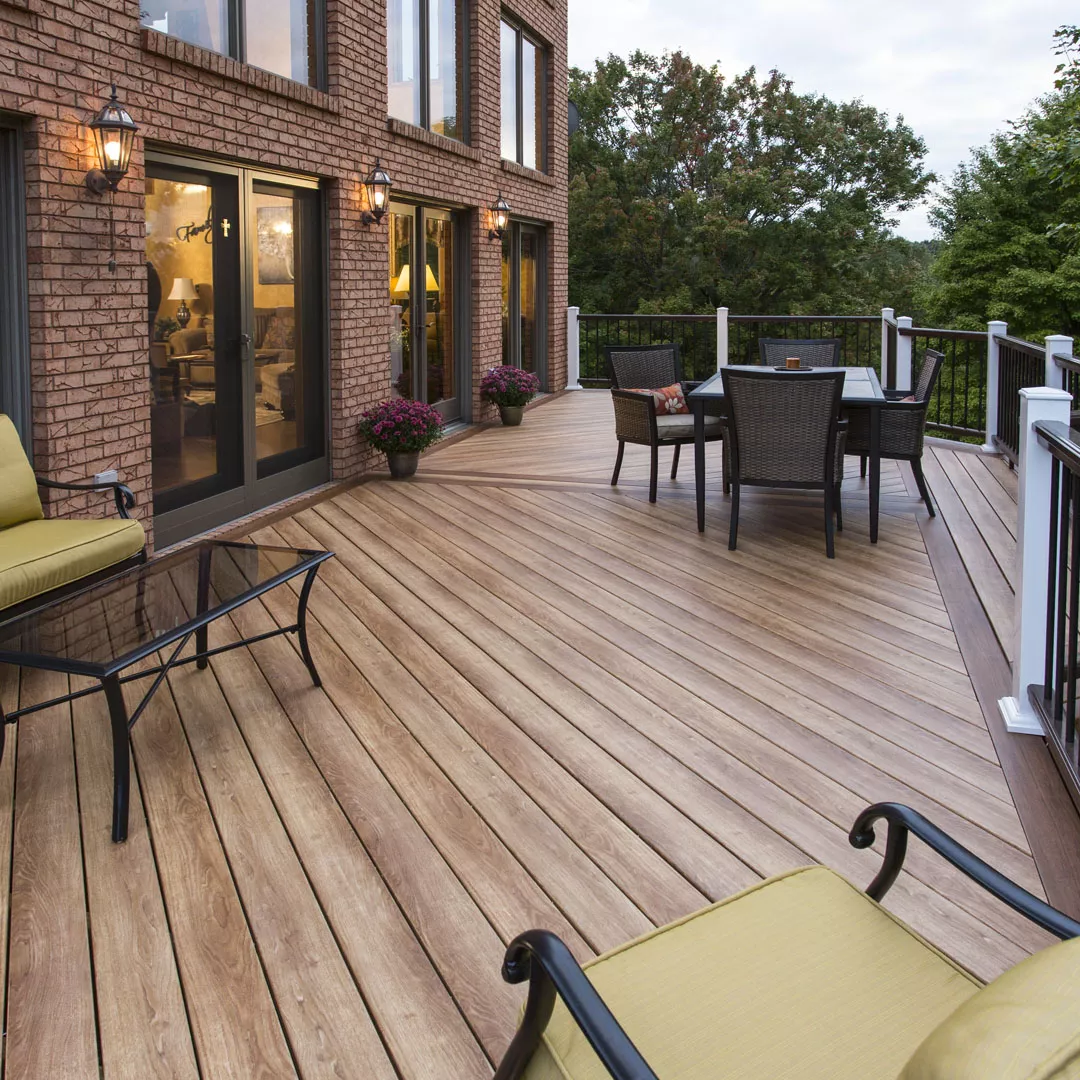
Nothing else in synthetic decking reproduces exotic hardwood the way Zuri does. Westlake Royal builds it in three layers: a cellular PVC substrate, a photo-realistic wood grain print, and a clear acrylic cap over the top.
That acrylic cap does more than protect the print. Westlake Royal reports the surface runs 30 percent harder than conventional non-wood decking and holds up five times better in abrasion testing. Zuri also meets ADA requirements for ramps, which opens up accessible and commercial work.
The colorfastness warranty runs 25 years and states its terms in measurable language: color will not shift more than five units on the Hunter scale. Most brands promise “resists fading” and leave it there. Zuri gives you a number you can test.
Colors include Chestnut, Walnut, Pecan, Brazilia, Weathered Gray and Hickory. Grooved boards ship in two gap widths, 3/32 inch and 3/16 inch, so you can match an existing deck.
Trade-off: Zuri costs more than everything else here and offers fewer colors. You buy it for the look.
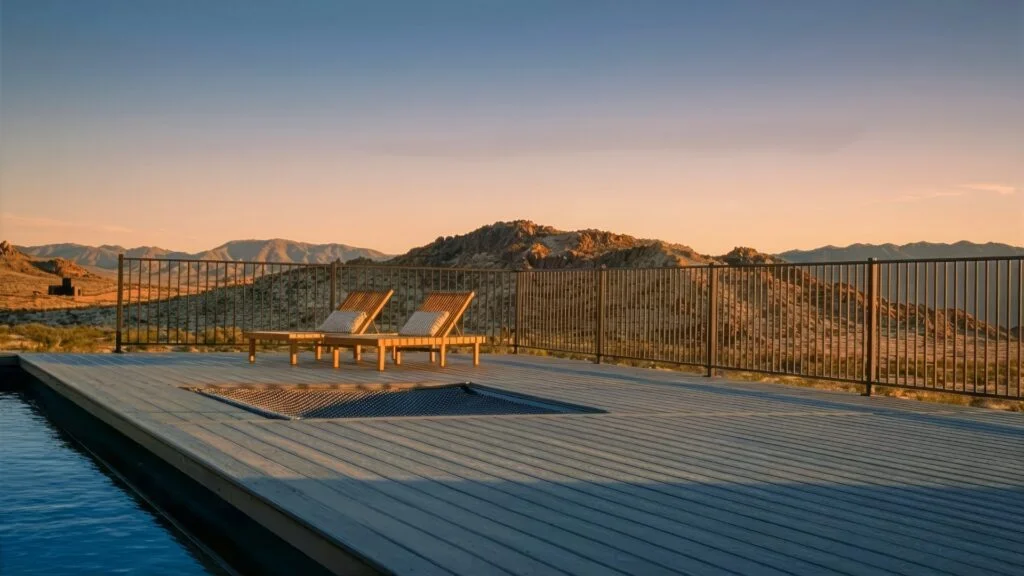
Trex announced Refuge on 13 January 2026, and it changed the shape of this category. Refuge is 100 percent cellular PVC, which puts the biggest name in composite decking into the PVC market for the first time.
Fire performance drives the product. Third-party testing gives Refuge an ASTM E84 Class A flame spread rating plus IWUIC ignition resistance under ASTM E2768. Homeowners building in wildfire-prone areas, where codes increasingly rule out standard boards, now have another option.
Trex covers Refuge with a 50-Year Limited Residential Warranty and manufactures it in the USA. The board uses a four-sided cap and a wire-brushed grain in two colors, Martis Valley and Point Reyes.
Read this before you spec it. Refuge ships in one profile only: solid, square edge, 1 inch by 5½ inches, in 16 and 20 foot lengths. You get no grooved board. Trex expects you to fasten it with Trex Hideaway fasteners and color-matched plugs, and it pairs with existing Trex fascia.
Trex also runs Refuge as a limited release in select regions. Confirm availability before you build a quote around it.
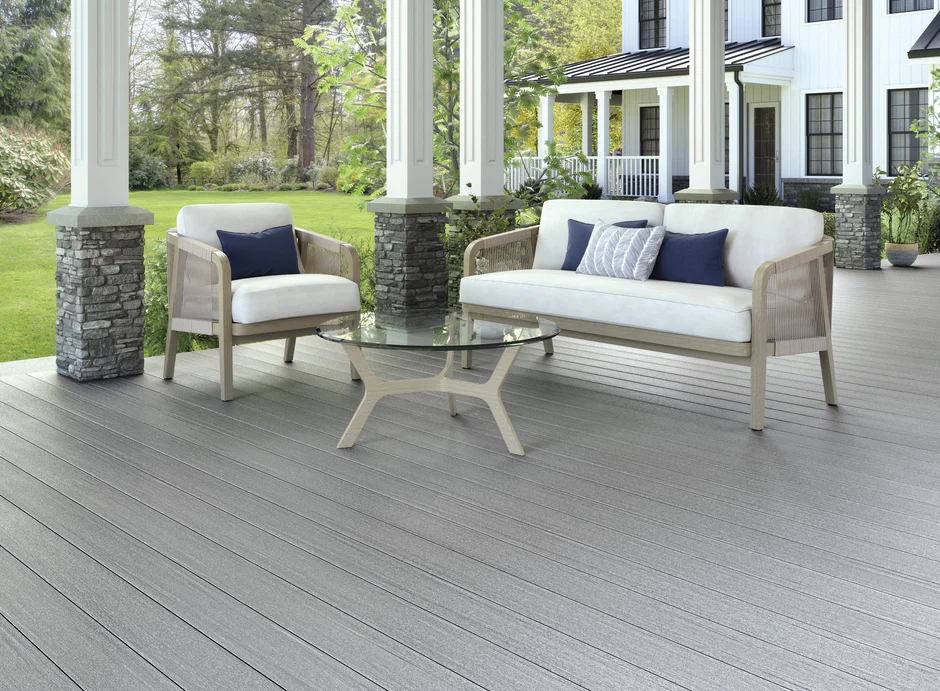
Fiberon builds the two PVC boards you want under a pool or on a dock. Both carry a lifetime performance warranty plus 50 years of stain and fade coverage.
Paramount uses a solid synthetic core with a three-sided cap and a slip-resistant surface texture. Fiberon tests it for fresh water, salt water and chlorinated water, and clears it for installations that go underwater temporarily, such as dock and pool stairs. The board measures 0.99 inch by 5.5 inches in 12, 16 and 20 foot lengths.
Promenade steps up to a four-sided cap and a rougher surface at 1.05 inch by 5.5 inches. That texture gives it the best wet traction of any board in this comparison. Colors run multi-tonal, and matching fascia measures ½ inch by 11¾ inch by 12 feet.
Both lines meet CA SFM 12-7A-4 Parts A and B and carry an ASTM E84 Class A flame spread rating. California WUI zones that prohibit wood decking accept them.
Best fit: marinas, docks, pool surrounds, and any surface people walk on barefoot and wet.
PVC decking brands we do not sell
Several other manufacturers make legitimate PVC deck boards. We do not sell them, and we would rather tell you than pretend they do not exist.
- Clubhouse Ultra PVC (Deceuninck) markets heavily on staying cooler than competing boards and on heat-bending for curves.
- Endeck (Enduris) sells capped cellular PVC aimed at decks and docks.
- Aeratis makes solid PVC porch flooring in tongue-and-groove profiles, not standard deck boards.
- CertainTeed EverNew LT shows up on older comparison lists and in existing installations.
Products people call PVC that are not PVC
This section clears up the confusion that costs people money.
Trex now sells both. Refuge is cellular PVC. Every other Trex line, including Signature, Transcend, Transcend Lineage, Select and Enhance, remains capped wood-plastic composite. Articles published before January 2026 state that Trex makes no PVC board. That was true then and it is wrong now.
Deckorators Voyage, Vault and Summit use mineral-based composite, branded Surestone, not PVC. The distinction carries real consequences. Mineral-based boards barely expand or contract with temperature, which is exactly why builders reach for them on docks.
MoistureShield and Envision sell capped wood-plastic composite.
Eva-Last builds bamboo-PVC composite. It contains organic material, so it does not behave like solid PVC.
Lumberock extrudes high-density polyethylene with mineral filler. Different polymer, different product.
Vinyl decking is not PVC decking. Vinyl decking describes a roll-out waterproofing membrane from brands like Duradek and Tufdek. You cannot build a deck surface out of it the way you build one out of PVC decking boards. Consumers use the two terms interchangeably and the industry does not.
How much do PVC deck boards cost in 2026?
PVC decking materials run roughly $9 to $18 per square foot. Installed, including framing, fasteners and labor, most projects land between $50 and $85 per square foot. Capped composite installs for $35 to $70 over the same scope.
These figures reflect national ranges reported by cost trackers including Angi, Ergeon and Remodel Calculators. Regional pricing swings hard, and our showroom pricing sits below several of these figures. Call for a real number.
| Deck size | PVC materials only | Installed range |
|---|---|---|
| 12 x 12 (144 sq ft) | $1,300 to $2,600 | $7,200 to $12,200 |
| 16 x 20 (320 sq ft) | $2,900 to $5,800 | $16,000 to $27,200 |
| 20 x 20 (400 sq ft) | $3,600 to $7,200 | $20,000 to $34,000 |
Estimate your own board count
Use the coverage math instead of guessing. A 5½ inch board plus a 3/16 inch gap covers 0.47 square feet per linear foot.
- 12 foot board covers 5.7 square feet
- 16 foot board covers 7.6 square feet
- 20 foot board covers 9.5 square feet
Divide your deck area by the coverage figure, then add 10 percent for cuts and waste. A 400 square foot deck built with 16 foot boards needs roughly 53 boards before waste, 58 after.
PVC vs. composite decking: the short version
| Factor | PVC decking | Capped composite |
|---|---|---|
| Material | 100% polymer, no wood | Wood fiber plus recycled plastic, capped |
| Moisture | Nothing to absorb water or feed mold | Cap blocks water, exposed cuts stay vulnerable |
| Heat | Cools down faster after sun exposure | Holds heat longer |
| Movement | Expands and contracts more | Moves less |
| Weight | Lighter, easier to handle | Heavier |
| Price | Higher | Lower |
| Best use | Docks, pools, coastal sites, fire zones | Most residential decks |
Both materials beat wood on maintenance and lifespan. Pick PVC when water, fire or barefoot comfort drives the decision. Pick composite when you want the most natural wood look for the budget.
Our full PVC vs. composite decking comparison covers appearance, lifespan and maintenance in depth.
What to check before you choose a PVC decking brand
Read the warranty as three separate documents
Manufacturers split coverage into a product warranty, a fade and stain warranty, and sometimes a labor warranty. A “lifetime” headline usually refers to the product warranty only. TimberTech and Fiberon pair lifetime product coverage with 50 years on fade and stain. Wolf and Trex publish fixed terms. Zuri writes its colorfastness promise as a measurable Hunter scale limit.
Ask about labor separately. Wolf PRO certified contractors add a five-year extended labor warranty, and Fiberon offers labor coverage through certified installers.
Match the profile to the fastener before you order
Grooved boards accept hidden fasteners. Square edge boards need face screws and plugs. Scalloped boards, like Wolf Haven, require the fastener system the manufacturer specifies.
This decision trips people up on Trex Refuge, which ships square edge only. Plan for Hideaway fasteners and color-matched plugs, and budget the extra install time.
Plan for movement
PVC expands and contracts more than capped composite and much more than mineral-based composite. Gap your boards according to the temperature on install day, and gap wider when you install in cold weather. Follow the manufacturer’s guide rather than a rule of thumb, because warranty claims hinge on it.
Frame at 16 inches on center for a straight board run. Drop to 12 inches on center for a 45 degree diagonal pattern. Some boards, including Harvest MAX, allow 24 inches on center.
Treat heat honestly
Every deck board gets hot in direct sun. PVC cools down faster than capped composite once the sun moves off it, and lighter colors run cooler than dark ones. TimberTech states this plainly in its own product documentation. Choose a lighter color for a south-facing deck with no shade.
Confirm fire ratings by collection
Class A flame spread and WUI compliance attach to specific collections, never to a whole brand. TimberTech Landmark and Vintage carry Class A. Harvest+ meets WUI. Trex Refuge carries Class A plus IWUIC ignition resistance. Fiberon Paramount and Promenade meet CA SFM 12-7A-4. Assume nothing about the rest.
Frequently Asked Questions
TimberTech Advanced PVC wins overall on the strength of five collections, a Limited Lifetime product warranty and 50 years of fade and stain coverage. Your project may point elsewhere. Choose Zuri for a hardwood look, Fiberon for wet traction, Trex Refuge for fire zones, and Wolf Serenity or Wolf Haven when budget leads.
Yes, since January 2026. Trex Refuge is the company’s first 100 percent cellular PVC board, built for ignition resistance in fire-prone areas. Every other Trex product line remains capped wood-plastic composite, so check the line name rather than the brand.
Expect $9 to $18 per square foot for PVC decking boards alone, and $50 to $85 per square foot installed. Labor, framing, railing and stairs drive most of the gap between those two figures. Board price varies by collection more than by brand.
Yes, and any brand claiming otherwise overstates its case. PVC cools down faster than capped composite once shade returns, and light colors stay noticeably cooler than dark ones. Position matters too, so a shaded or east-facing deck stays comfortable longer.
Warranty terms give you the honest answer. Leading PVC decking brands back their boards with 25 to 50 year fade and stain coverage, and several add a limited lifetime product warranty. PVC contains no organic material to rot, so failures usually trace back to installation rather than the board.
PVC handles water better than any other decking material. Fiberon tests Paramount and Promenade in fresh, salt and chlorinated water and clears them for temporary submersion. Wolf Serenity targets the same conditions, and TimberTech Harvest MAX spans 24 inch framing for dock construction.