The place for all your outdoor living space!

Two deck boards can sit side by side in a showroom, look nearly identical, and carry warranties 25 years apart. That gap is why this ranking exists. The photography across composite decking brands has converged over the last few years. The spec sheets have not.
We stock nine composite and PVC brands across our Plainfield and Spring Grove showrooms, and our team has handled every board below.
Composite decking brands ranked for 2026
| # | Brand | Best for | Core material | Cap | Warranty range |
|---|---|---|---|---|---|
| 1 | Trex | Best overall | Wood flour + recycled polyethylene | 3-sided | 25, 35 or 50 yr |
| 2 | TimberTech | Best wood grain | Wood fiber + recycled polymer | 3 or 4-sided | 25 to 30 yr |
| 3 | Deckorators | Best for wet sites and DIY | Mineral + polypropylene | 4-sided | Up to 50 yr structural |
| 4 | Fiberon | Best value | Wood fiber + recycled polymer | 3 or 4-sided | 25 to 50 yr |
| 5 | MoistureShield | Best for docks | Solid-core wood composite | 4-sided | 25 to 50 yr structural |
| 6 | Envision | Best solid-core board | Solid-core composite | Capped | Varies by collection |
| 7 | Wolf | Best regional value | Wood fiber + recycled polymer | Capped | 25 yr typical |
| 8 | Eva-Last | Best bamboo alternative | Bamboo fiber + polymer | Capped | 25 yr typical |
How we ranked them
Four things decide almost every real buying decision. We weighted them in this order, then used color range and availability to break ties.
What the core is made of
The core is the structural body of the board sitting under the cap, and it decides how the board handles water. Three types dominate the market in 2026.
Wood-plastic composite blends ground wood fiber with recycled polyethylene, which is what Trex, Fiberon and TimberTech’s composite lines use. Mineral-based composite swaps the wood out for mineral filler and polypropylene, the approach behind Deckorators Surestone. PVC drops organic material entirely, as in TimberTech Advanced PVC, Wolf Serenity and Zuri.
The practical difference: wood fiber in a core can hold moisture if water ever reaches it. Mineral and PVC cores cannot, which is exactly why those boards carry ground and water contact ratings that most wood-based composites do not.
How many sides the cap covers
A three-sided cap leaves the bottom of the board open. Manufacturers do that on purpose so any trapped moisture can escape downward, and Trex builds its entire range this way. Four-sided capping seals the board completely instead.
Neither approach is wrong. Three-sided performs well on a normally ventilated deck sitting 12 inches or more off grade. Four-sided is the safer call for low-clearance framing, pool surrounds, docks and anywhere water tends to stand underneath.
What the warranty actually pays for
Most brands publish two separate warranty documents, and buyers routinely read only the bigger number. The product or structural warranty covers rot, splintering and structural failure. The fade and stain warranty covers color holding and surface staining, and it is usually the shorter of the two.
On the composite side, TimberTech’s Legacy, Reserve and Terrain collections carry 30 years, while Prime+, Prime and Premier carry 25. Trex splits its range across 25, 35 and 50-year terms depending on the line, and Deckorators now publishes a 50-year structural guarantee on its Surestone boards. Fiberon Concordia reaches 50 as well.
Two things people assume and shouldn’t: that coverage automatically transfers when you sell the house, and that it isn’t prorated. Read both documents before you commit.
How hot the boards get
Every composite board heats up in full sun, and every honest manufacturer says so. How much varies, and color drives it more than the brand name does. A light board from a value line will run cooler than a dark board from a premium one.
Brands attack heat two ways. Infrared-reflective cap pigments reflect part of the solar load, which is what Deckorators Surestone and MoistureShield CoolDeck do. Trex applies heat-mitigating technology to Transcend Lineage. TimberTech says plainly that all of its boards get hot in the sun and recommends lighter colors in hot climates.
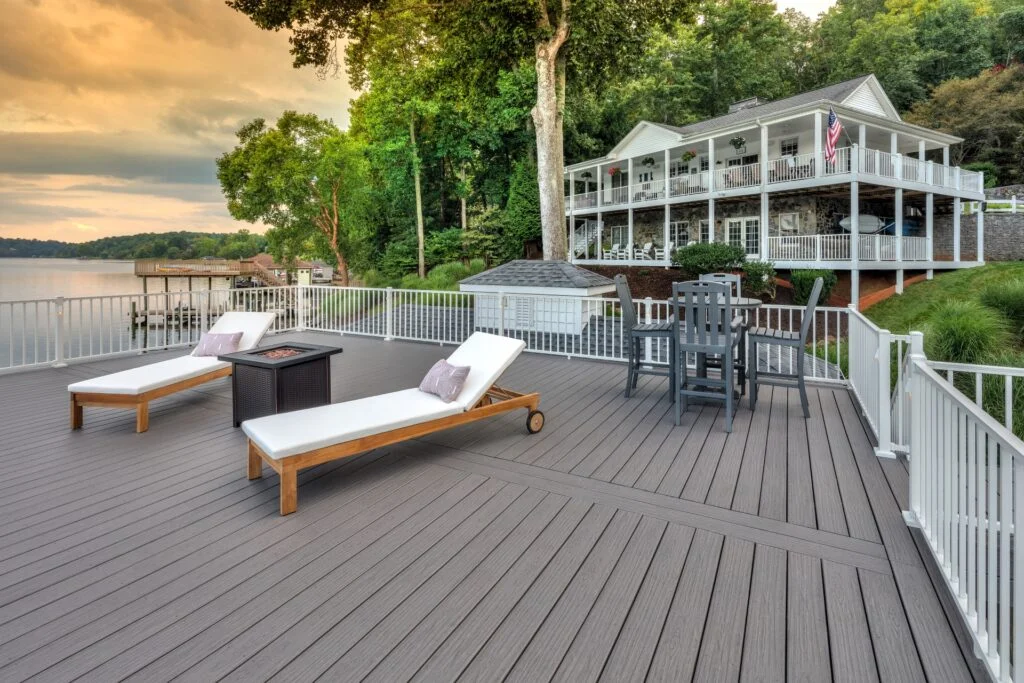
Trex: best composite decking brand overall
Trex is the reference point in this category, with the widest dealer network of any composite decking brand. The lineup runs Signature, Transcend Lineage, Transcend, Select and Enhance, which covers the full price ladder inside one fastener system. That last part matters more than people expect when a job runs long and you need to resupply.
Recycled content is a Trex talking point worth reading closely. Most lines are certified at 95.4% recycled material by weight, but Signature sits at 92.6%. Plenty of articles quote a flat 95% across the whole range, and that number is wrong for the top line.
Here is something that rarely makes it into brand comparisons. Stair stringer spacing tightens to 9 inches on center for Select and Enhance, against 12 inches for Signature, Transcend and Lineage. Miss it and the stairs feel springy on a deck that is otherwise built correctly.
Go with Trex if you want the largest color selection, matching railing and lighting from a single manufacturer, and the easiest product to source mid-project.
TimberTech: best warranty and best wood look
TimberTech, part of the AZEK Company, is the brand to put next to Trex. Its composite collections are Legacy, Reserve, Terrain, Prime+, Prime and Premier, blending reclaimed wood fiber with recycled polymer across four price tiers.
Legacy and Reserve produce the most convincing hardwood grain of any composite board we stock. The wire-brushed, multi-tonal surface reads as real timber from standing height, where most composites at that price still read as a repeating pattern. That realism is usually what people walk in asking for, even when they describe it another way.
One warning before you order. TimberTech also sells Advanced PVC collections (Vintage, Landmark, Harvest+, Harvest) under the same brand name and in the same displays, and those are not composite. Customers pick a collection without registering which of the two lines it belongs to, and it is the most common mix-up we correct at the counter.
Go with TimberTech if you want multi-tonal wood grain rather than uniform color.
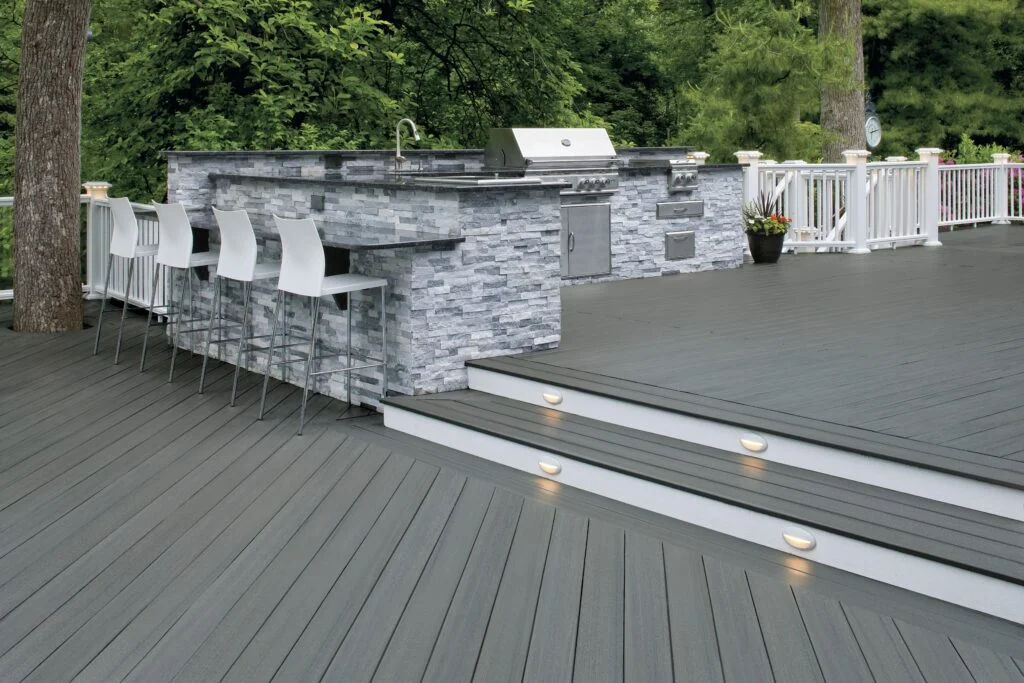
Deckorators: best for wet sites and DIY installs
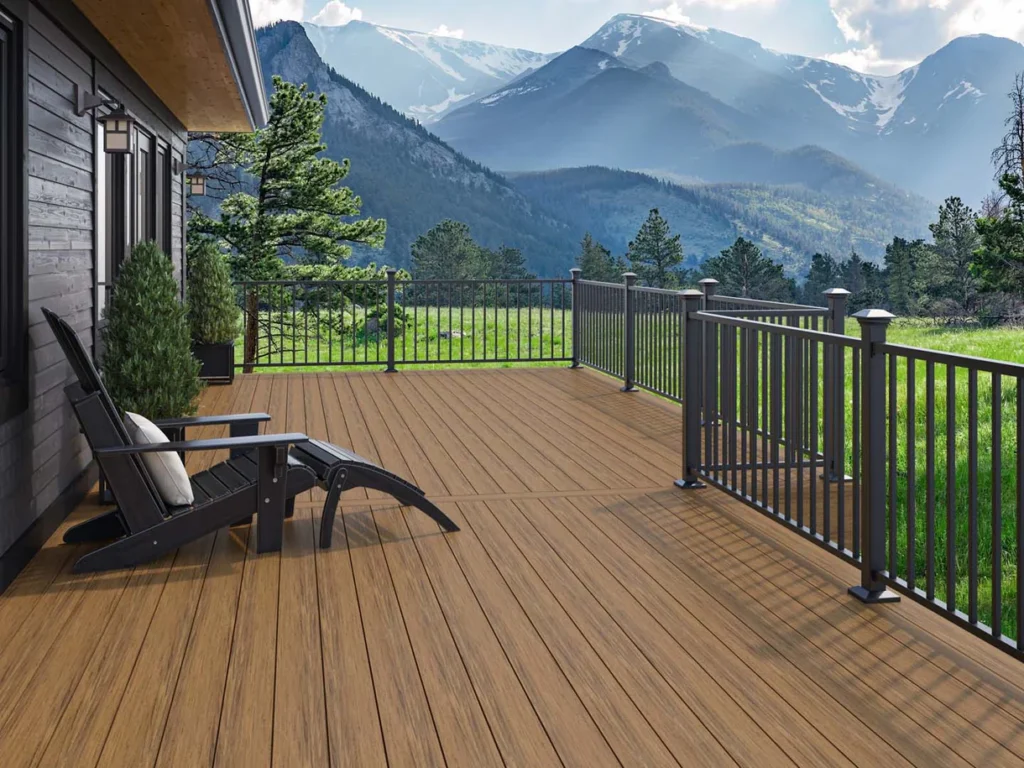
Deckorators took a different engineering route with Surestone, a mineral and polypropylene blend with no organic material in it. Since the core absorbs virtually no moisture, Voyage, Summit and Picture Frame Board are rated for installation in the ground or in water, which very few boards on this list can claim.
Those boards also run around 35% lighter than traditional composites, with a slip-resistant surface Deckorators rates at 34% more traction in wet conditions. If you are carrying and cutting every board yourself, you notice the weight difference by the second course.
One thing to confirm before ordering: not every Deckorators line is mineral-based. Vista and Heritage are conventional wood composites and do not carry the same ground contact rating, so check the specific line rather than the brand name.
Go with Deckorators if you are building near water, want the best wet traction, or are installing solo.
Fiberon: best value in composite decking
Fiberon, owned by Fortune Brands, is where four-sided capping shows up without top-tier pricing. Concordia, Sanctuary and Paramount carry the longer terms and the full cap, while Good Life and ArmorGuard hold down the value end of the range.
Fiberon also lists limited residential labor warranty coverage on select products when the deck is installed by a pre-qualified Fiberon Certified Installer. Almost nobody else in the category does that, so it is worth asking about if you are hiring the build out rather than doing it yourself.
Surface texture is the other reason people land here. Concordia runs a heavier embossed grain than most mid-priced composites, so the boards do not read as plastic from a standing height the way cheaper capped decking sometimes does.
Go with Fiberon if you want a fully sealed board and 50-year coverage without paying premium-brand pricing.
MoistureShield: best for docks and ground contact
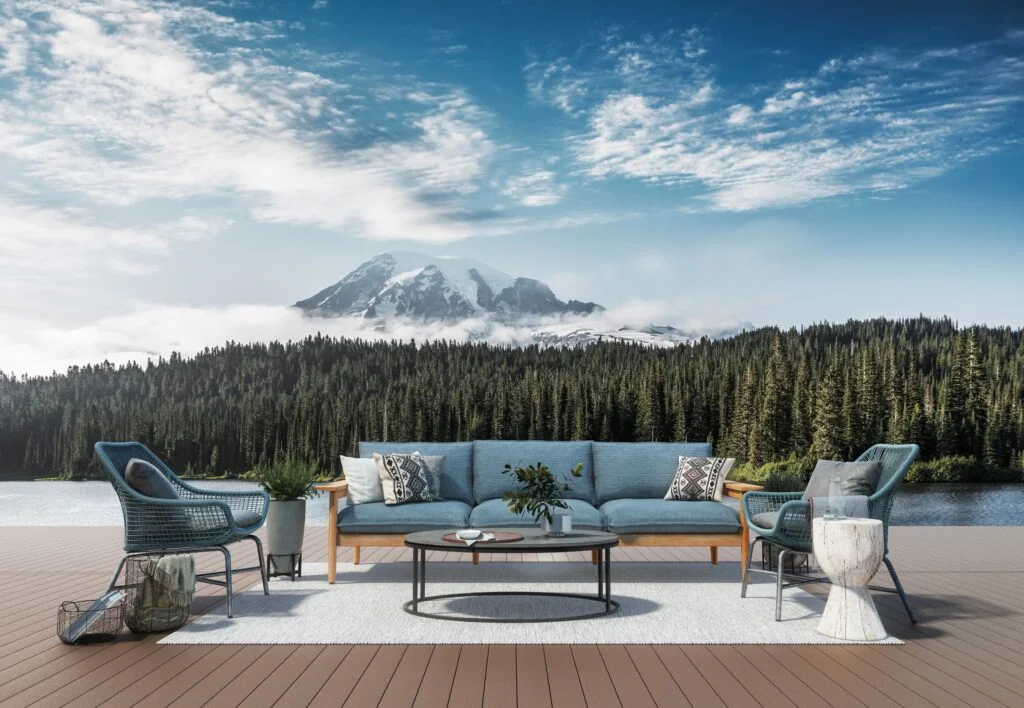
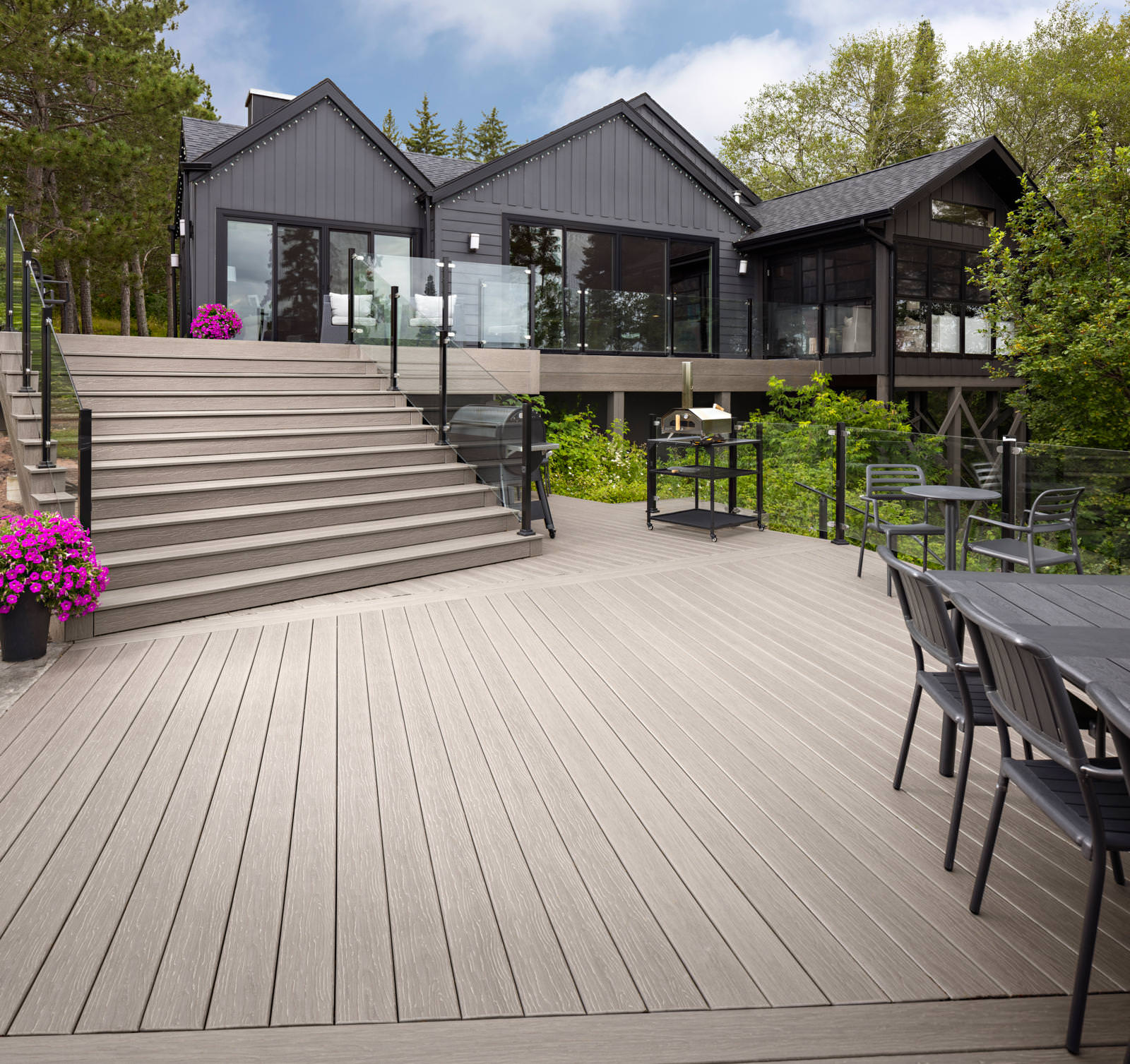
MoistureShield is built around one claim and it delivers on it. Every board the company makes is approved for ground contact and can be submerged, which is why it turns up as the standard spec on docks, boardwalks and decks sitting inches off wet ground.
The range splits three ways. Vision is the flagship, adding CoolDeck technology that the company rates as running significantly cooler underfoot than a conventional capped composite in the same color, and it carries a 50-year structural warranty. Elevate and Meridian sit below it at 25 years.
Color range is narrower than Trex or Fiberon, and the palette leans toward browns and grays rather than the full spread. On a waterfront lot that is an easy trade to make.
Go with MoistureShield if the deck sits close to grade, over water, or anywhere drainage is a genuine problem.
Envision: best solid-core board
Envision, built by Tamko, runs solid-core boards across Distinction, Expression, Ridge Premium and EverGrain. Solid construction means more material per board and more stiffness underfoot, which some builders prefer on longer joist spans or on a deck that will see heavy furniture.
Grain variegation is the visual draw here. Distinction in particular carries color streaking through the board rather than a single flat tone, and it photographs closer to real timber than most boards at its price.
Two practical notes. The boards are heavier than a scalloped-bottom composite, so plan the delivery and the carry accordingly. Warranty terms also differ by collection rather than running across the brand, so confirm the specific line before you order rather than assuming.
Go with Envision if you want a dense board with strong color variation and do not need a ground contact rating.
Wolf: best regional value
Wolf, from Wolf Home Products, spans two materials under one brand, and the distinction catches people out. Serenity is cellular PVC with no wood content, sitting closer to TimberTech Advanced PVC than to a standard composite. Perspective and the composite lines cover the wood-blend side at a more accessible price point.
The appeal here is a lower entry point into PVC than the national premium brands ask for. If you want a board with no organic material in it but the TimberTech and Zuri numbers are outside the budget, this is the bracket to look at.
Availability is regional with this brand, which is the main caveat. Around Chicago the lineup is straightforward to source and restock, and that is not true in every market.
Go with Wolf if you want PVC performance at a lower entry point than the national premium lines.
Eva-last: best bamboo alternative
Eva-Last builds its boards on bamboo fiber instead of wood flour, across the Apex, Infinity and Pioneer ranges. Bamboo regrows in a fraction of the time timber takes, so the sustainability argument here is genuinely different from the recycled-plastic pitch you hear from everyone else.
Coloring leans warm and tropical, with more red and amber in the palette than the gray-heavy ranges that have dominated the last few years. If the Trex and TimberTech palettes read too cool against your siding, start here.
Profiles vary more than they do elsewhere in this list, with both solid and ribbed board options depending on the range. Confirm which profile a color comes in before you plan the fastening, since it affects the hidden clip system.
Go with Eva-Last if you want warm tones and a bamboo-based board rather than a recycled-plastic one.
Best composite decking brand by situation
- Dock, boardwalk or ground contact: MoistureShield, or Deckorators Voyage and Summit
- Pool deck or barefoot traffic: Deckorators Surestone, TimberTech Advanced PVC in a light color
- Longest warranty on paper: TimberTech Advanced PVC
- Widest color and accessory range: Trex
- Four-sided cap on a mid-range budget: Fiberon Concordia or Sanctuary
- DIY build with no crew: Deckorators, for the weight
- Hardwood look without hardwood upkeep: Zuri, then TimberTech Vintage
- Lowest entry price: Trex Enhance, Fiberon Good Life, TimberTech Prime
What the best composite decking brands cost in 2026
Board-only pricing around Chicago generally lands between $5 and $15 per square foot, and it moves with the collection rather than the brand. An entry composite line and a premium PVC line from the same manufacturer can sit at opposite ends of that range.
Installed cost is a different conversation. Regional builder data for Illinois puts a finished composite deck at $40 to $70 per square foot, with labor running roughly $10 to $15 per square foot on a resurface and $20 to $35 on a new build. Framing, stairs, railing and footings drive most of that variance, not the deck boards.
Budget for the whole assembly rather than the surface. Hidden fasteners, fascia, railing and lighting routinely add 30% or more on top of the boards, and each brand’s fastener system is matched to its own groove profile.
Mistakes we see in the showroom
Choosing from a 3-inch sample is the big one. Color reads completely differently across 300 square feet in daylight. Take a full board home and look at it against your siding at the time of day you actually use the deck.
Mixing lines within a brand catches people too. Board thickness varies by collection, so Trex Select at 0.82 inches and Transcend at 0.94 will not sit flush in the same field.
Then there is the headline warranty. That 50-year number almost always belongs to one of two documents, and it is worth knowing which one before you buy.
Last, joist spacing. Composite boards need 16 inches on center running straight and 12 inches at 45 degrees. A frame built for wood on 24-inch centers won’t take most composite decking without reframing first.
Frequently asked questions
Trex ranks first overall for color range, accessory matching and availability across price points. TimberTech takes the wood-grain category, Deckorators wins on wet sites and board weight, and Fiberon offers the best four-sided capping per dollar. The right pick depends on your site more than on any ranking.
For structural durability in moisture, mineral-based boards perform best because their cores contain no organic material. Deckorators Surestone and MoistureShield carry ground and water contact ratings that most wood-based composites do not. For surface durability against scratching and fading, four-sided capped boards outperform three-sided.
They lead on different specs. On composite boards Trex carries the longer warranty at 50 years against TimberTech’s 30, plus more colors, more accessories and wider dealer coverage. TimberTech answers with better wood grain on Legacy and Reserve. Compare the specific collections rather than the brands.
A properly installed capped composite deck typically lasts 25 to 30 years or more, and the warranty terms reflect that. Framing usually fails before the deck surface does. Ledger flashing and joist protection affect how long a deck lasts far more than the brand of board on top.
Entry collections set the floor rather than entry brands. Trex Enhance, Fiberon Good Life and TimberTech Prime are the usual value picks, generally starting near $5 per square foot for boards only. Confirm current pricing before you budget, since composite pricing moves with resin costs.
Every composite board heats up in direct sun, and color affects it more than the brand does. Boards with infrared-reflective caps, including Deckorators Surestone and MoistureShield Vision with CoolDeck, run measurably cooler than standard composites. Picking a lighter color is the single most effective thing you can do about it.
See the 2026 boards side by side
Comparing composite decking brands on a screen only gets you so far. Grain depth, surface texture and true color all read differently in person, and that is usually where the decision actually gets made.
Premium Decking Supply carries Trex, TimberTech, Fiberon, Deckorators, MoistureShield, Envision, Wolf and Eva-Last across showrooms in Plainfield and Spring Grove, Illinois, alongside the PVC lines if you want to compare the two materials side by side. Bring your deck dimensions and we will work out board counts and pricing with you.
Call (815) 439-DECK or (815) 479-DECK for a board count and current pricing, or stop into either showroom to compare brands in person.