The place for all your outdoor living space!

Article Overview
- Best Way to Remove Snow From Composite Decking
- Can Shoveling Snow Affect a Composite Deck Warranty?
- How to Remove Snow From Composite Decking Step by Step
- Which Tools Are Safe for Removing Snow From Composite Decking?
- Can You Use a Snow Blower on a Composite Deck?
- What Not to Use When Removing Snow From a Deck
- Removing Light Snow vs. Heavy Snow
- Do You Need to Remove All Snow From a Composite Deck?
- How to Prevent Scratches While Shoveling a Composite Deck
- Winter Snow Removal Tips for Deck Builders and Contractors
- Quick Composite Deck Snow Removal Checklist
- Protect Your Composite Deck Through Winter
- Frequently Asked Questions About Removing Snow From Composite Decking
A snow-covered composite deck may look harmless. The wrong shovel or removal technique can leave scratches, gouges, or damaged board edges.
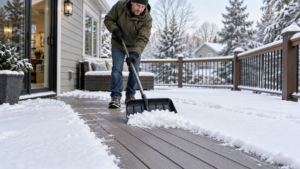
The safest way to remove snow from composite decking is to use an all-plastic snow shovel, work in the direction of the deck boards, and avoid scraping frozen material from the surface. For light snow, a soft broom or leaf blower may be enough.
Composite decking is durable, but the finished surface still needs proper care. Metal edges, sharp ice tools, trapped gravel, and aggressive scraping can cause permanent marks.
This guide explains the best way to remove snow from a deck, which tools to use, what to avoid, and how to clear snow without creating unnecessary surface damage or warranty concerns.
Best Way to Remove Snow From Composite Decking
Match the removal method to the amount and condition of the snow.
For light, dry snow, use:
- A soft-bristle broom
- A clean push broom
- A leaf blower
For deeper snow, use:
- An all-plastic snow shovel
- A poly shovel with no metal cutting edge
- Short, controlled pushes along the deck boards
For packed snow or frozen buildup, avoid forcing a shovel underneath it.
Do not treat composite decking like a concrete driveway. Your goal is to move loose snow without grinding tools against the finished surface.
Can Shoveling Snow Affect a Composite Deck Warranty?
Improper snow removal can cause damage that may not be covered by the decking manufacturer’s warranty.
That does not mean one mistake automatically cancels the entire product warranty.
The bigger issue is damage caused by improper care. Scratches, gouges, chips, stains, or surface damage caused by tools or maintenance methods may fall outside warranty coverage.
Before removing snow, check the care instructions for your exact decking product.
Pay attention to:
- Approved snow-removal tools
- Prohibited metal edges
- Surface-care instructions
- Winter maintenance requirements
- Warranty exclusions related to physical damage
Keep the product name and care guide with your deck records. That makes future maintenance much easier.
How to Remove Snow From Composite Decking Step by Step
1. Check the Deck Surface Before You Start
Take a quick look at the snow before reaching for a shovel.
Light powder needs much less force than heavy, wet snow. Packed snow and frozen layers require even more care.
Also look for debris beneath or mixed with the snow.
Small stones, gravel, construction debris, or hardened dirt can become trapped beneath a shovel blade and scratch the decking as you push.
If possible, remove visible debris first.
2. Inspect Your Snow Shovel
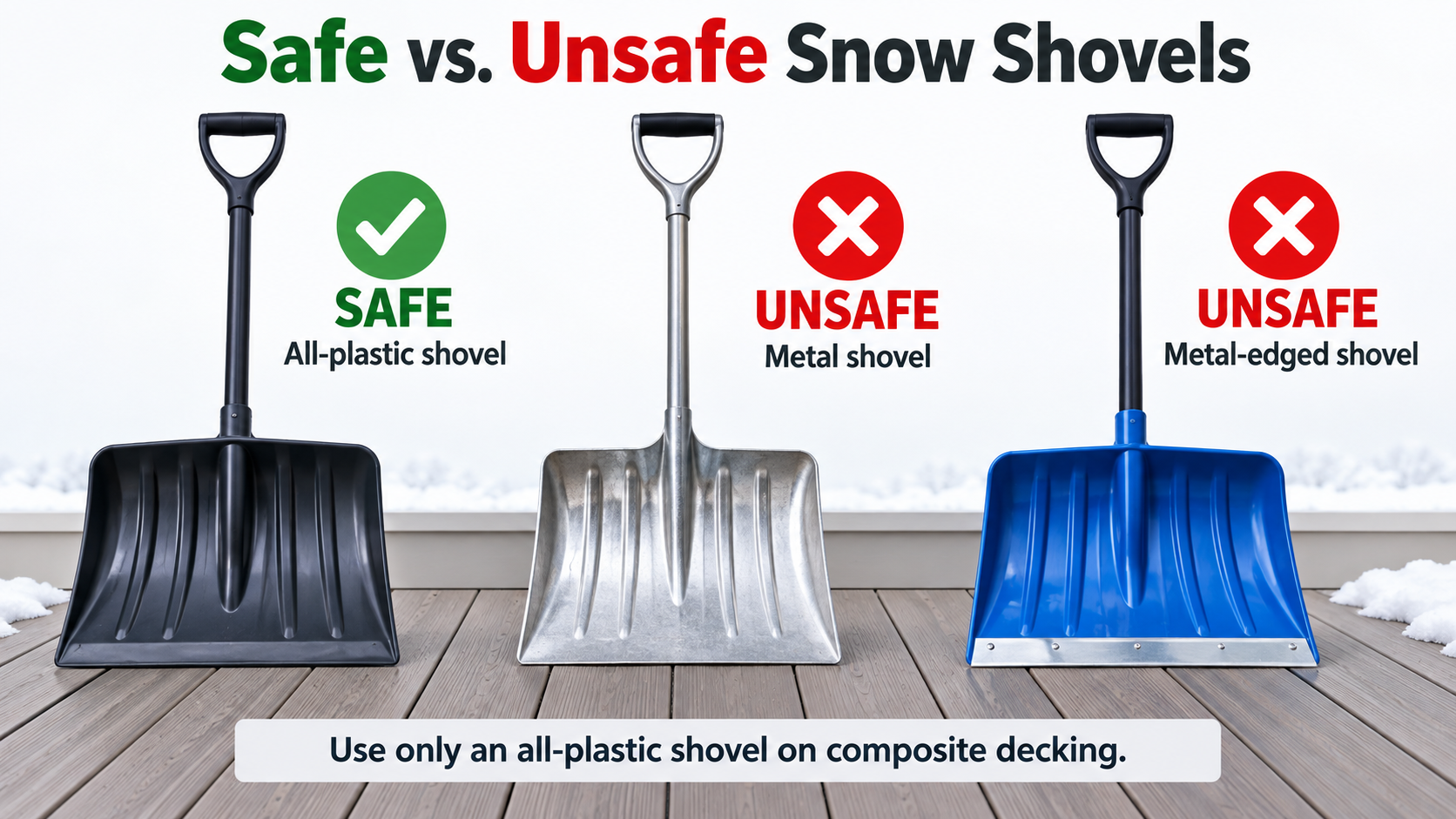
Use an all-plastic shovel without a metal leading edge.
Some snow shovels have plastic bodies but include a thin steel or aluminum strip along the bottom. That edge may be useful on concrete, but it can scratch composite decking.
Check the shovel for:
- Metal reinforcement
- Sharp or damaged corners
- Cracked plastic
- Exposed screws
- Embedded stones
- Sand or grit stuck to the blade
A clean plastic shovel is much safer than a worn driveway shovel.
For homeowners with both a driveway and deck, consider keeping a separate shovel for the deck.
3. Clear Doorways and Stairs First
Start with the parts of the deck people actually need to use.
Clear a safe path from exterior doors to stairs, gates, and other exits.
Pay close attention to stair treads. Foot traffic can compress loose snow into a hard layer that becomes more difficult to remove later.
You usually do not need to scrape every inch of the deck completely clean after a light snowfall.
Focus on safe access first.
4. Push Snow in the Direction of the Deck Boards
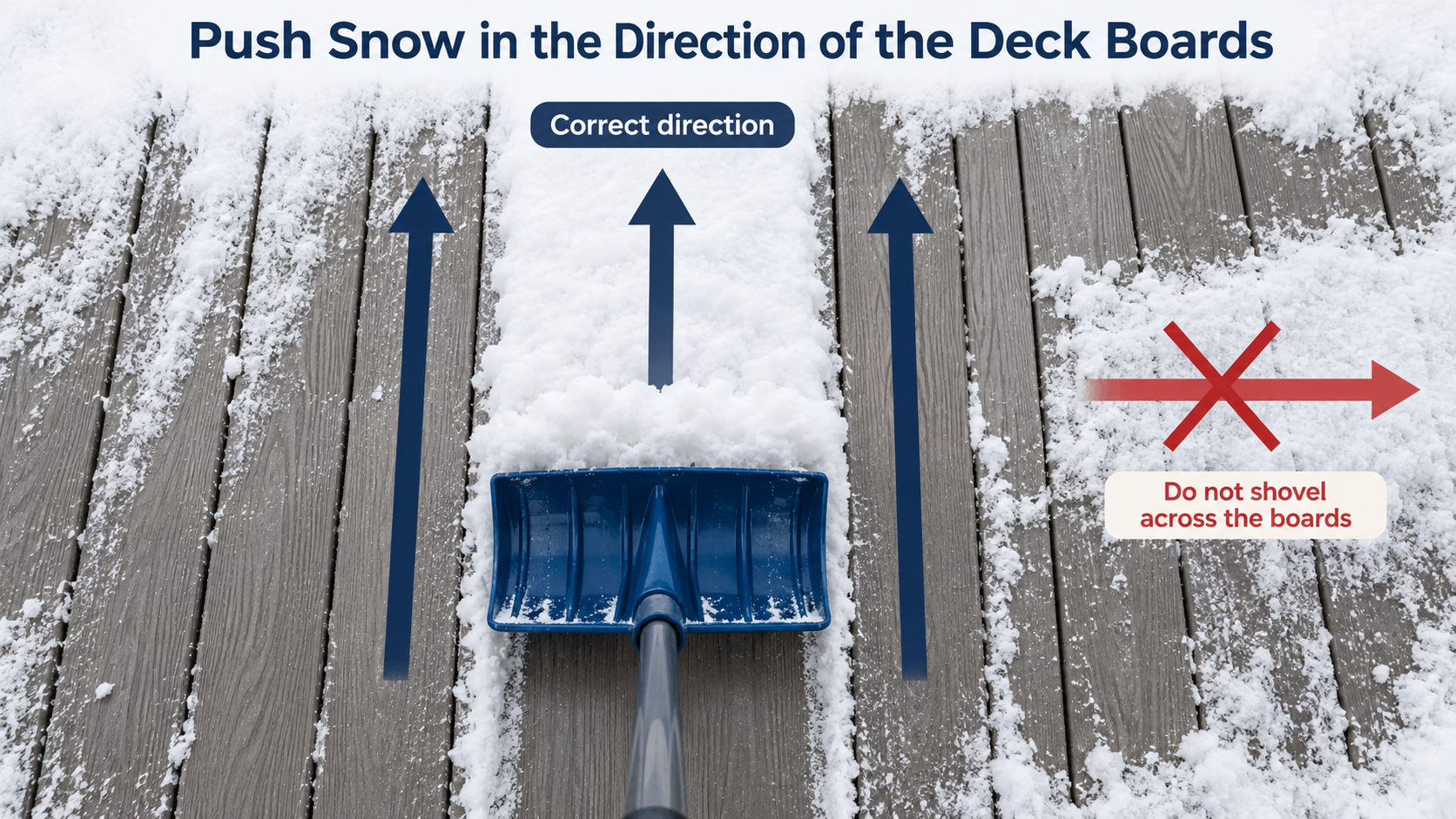
Whenever possible, shovel parallel with the deck boards.
This reduces the chance of catching the shovel on a board edge or gap.
Pushing across the boards can cause the shovel blade to repeatedly pass over gaps. A corner of the shovel may catch if you use too much pressure.
Use smooth, controlled movements.
Let the shovel move the snow rather than forcing the blade against the deck.
5. Remove Heavy Snow in Layers
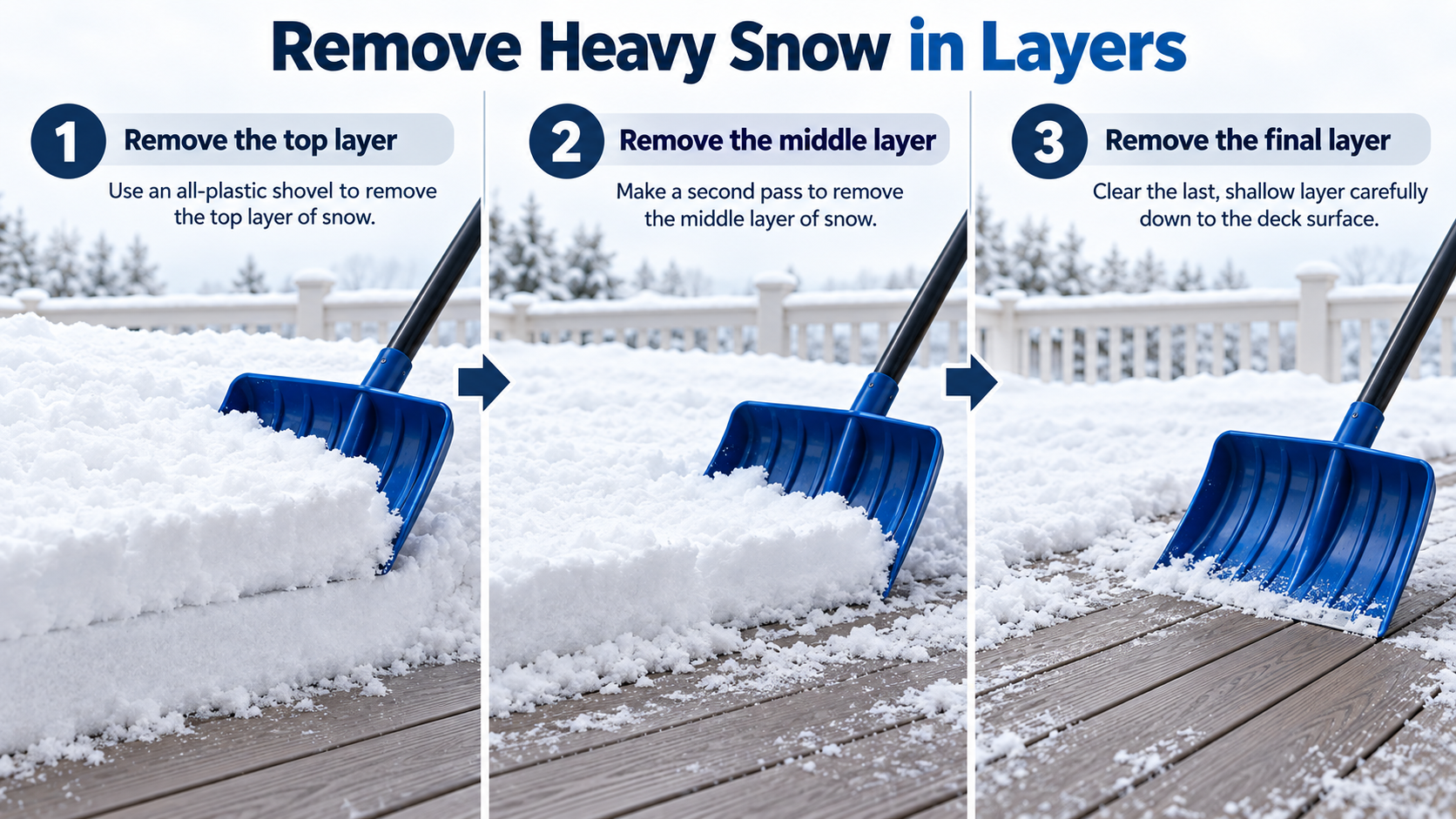
Wet or deep snow can become very heavy.
Do not try to push the entire depth in one pass.
Take off the upper layer first. Then return for the snow closer to the boards.
Removing snow in layers gives you better control and reduces the force required against the deck surface.
It also reduces the chance of the shovel suddenly catching on a board edge.
6. Lift Snow Instead of Pushing Huge Piles
Long pushes may seem faster, but they can create a heavy pile in front of the shovel.
Once the pile becomes difficult to move, people often start pushing harder. That extra pressure can force the shovel blade against the decking.
Use shorter passes instead.
Move smaller amounts of snow and lift them off the deck when practical.
7. Do Not Scrape the Deck Clean
You do not need to expose every inch of decking by force.
Once the shovel reaches a thin layer of packed snow or frozen material, stop scraping.
If ice remains after the loose snow is removed, use a deicer that is approved for your decking. See our guide to ice melt for composite decking for product-specific recommendations and winter-use guidance.
Trying to remove the final layer with repeated shovel strokes creates unnecessary friction against the board surface.
Allow natural warming or an appropriate winter treatment to loosen frozen material instead.
For information about choosing ice-melting products, see our guide to ice melt for composite decking, which covers manufacturer-specific recommendations separately.
8. Watch Where You Put the Snow
Do not create one massive snow pile against the railing or house if you can avoid it.
Spread removed snow across suitable areas around the deck.
Large piles may:
- Block doors or stairs
- Cover drainage areas
- Freeze around railing posts
- Melt and refreeze across walking paths
- Create unnecessary concentrated loads
Plan where the snow will go before you start clearing a large deck.
Which Tools Are Safe for Removing Snow From Composite Decking?
The tool matters as much as the technique.
| Tool | Recommended Use | Surface Risk |
|---|---|---|
| All-plastic snow shovel | Normal snowfall | Low when used properly |
| Soft-bristle broom | Light powder | Low |
| Leaf blower | Light, dry snow | Low |
| Plastic push broom | Light snow | Low |
| Plastic shovel with metal edge | Avoid | High |
| Metal shovel | Avoid | High |
| Ice pick or ice chopper | Avoid | Very high |
| Metal scraper | Avoid | Very high |
| Sand or abrasive grit | Avoid unless manufacturer approves | May scratch |
| Snow blower | Check product guidance first | Depends on equipment |
For a small amount of powder, a leaf blower can eliminate surface contact completely.
A soft broom is also useful when the snow is light enough to sweep.
Once the snowfall becomes deeper, an all-plastic shovel is usually the practical choice.
Can You Use a Snow Blower on a Composite Deck?
Use caution.
A snow blower may seem like an easy solution for a large deck, but several parts of the machine can create problems.
Depending on the design, the equipment may have:
- Scraper bars
- Metal augers
- Hard wheels
- Skid shoes
- Sharp lower edges
Debris picked up by the machine can also strike the decking or nearby railing.
Do not assume a snow blower designed for asphalt or concrete is safe for composite decking.
Check both the decking manufacturer’s care instructions and the snow blower design before using one on a deck.
When in doubt, an all-plastic shovel provides much more control.
What Not to Use When Removing Snow From a Deck
Several common driveway tools should stay away from composite decking.
Metal Snow Shovels
Avoid steel and aluminum snow shovels.
Metal edges can scratch, gouge, or mark the board surface.
The same rule applies to plastic shovels fitted with metal wear strips.
Ice Picks and Choppers
Do not chip bonded ice from composite decking.
The concentrated impact from an ice chopper can damage the surface and leave permanent marks.
This includes aggressive use of plastic ice choppers.
Plastic does not automatically make a tool safe if you are striking the deck with it.
Metal Scrapers
A flat metal scraper works well on some concrete surfaces but should not be used to scrape a composite deck.
The sharp edge can cut into the board finish.
Sand and Abrasive Materials
Sand may improve traction, but the grains can become trapped under shoes and snow-removal tools.
That can turn normal foot traffic into an abrasive action across the decking surface.
Follow your decking manufacturer’s care instructions before using any traction product.
Boiling Water
Pouring boiling water over frozen areas is not a good snow-removal method.
The water may quickly cool and refreeze, creating another slippery surface.
It can also run into board gaps, stairs, or surrounding areas before freezing again.
Aggressive Scraping
Even an all-plastic shovel can damage a deck when used incorrectly.
Do not turn the shovel edge into a scraper.
Use it to move loose snow, not shave frozen material from the surface.
Removing Light Snow vs. Heavy Snow
Different storms call for different methods.
Light Powder
This is the easiest snow to remove.
Try a:
- Leaf blower
- Soft broom
- Plastic push broom
Removing light snow before people walk across it can also prevent it from becoming compacted.
Wet Snow
Wet snow is much heavier.
Use an all-plastic shovel and work in short sections.
Lift or push smaller amounts instead of forcing one large pile across the deck.
Deep Snow
Remove deep snow in layers.
Start with the upper portion and gradually work down toward the decking.
This method requires less force and gives you more control over the shovel.
Packed Snow
Do not scrape aggressively.
Remove whatever is loose and leave the remaining packed layer until it can be safely loosened.
Frozen Ice
Never chop or pry ice from the deck.
Use the winter-care method approved for the decking product rather than trying to break the ice mechanically.
Do You Need to Remove All Snow From a Composite Deck?
Not every snowfall requires clearing the entire deck down to bare boards.
For a light snowfall, focus first on areas needed for safe use.
These often include:
- Exterior doors
- Deck stairs
- Main walking paths
- Gates
- Access to grills or equipment
- Areas prone to refreezing
Structural snow concerns are different from normal surface maintenance.
Snow weight depends on moisture content, depth, drifting, ice buildup, and weather conditions. Deck framing, span, age, and local design loads also matter.
Avoid relying on a universal snow-depth rule.
If you notice unusual sagging, movement, loose connections, or extreme snow accumulation, avoid using the deck until the structure can be evaluated.
How to Prevent Scratches While Shoveling a Composite Deck
Good technique can prevent most snow-removal damage.
Keep a Dedicated Deck Shovel
Store an all-plastic shovel specifically for the deck.
Mark it DECK ONLY if several people maintain the property.
This prevents someone from grabbing a metal-edged driveway shovel during a storm.
Keep the Shovel Clean
Inspect the blade before every use.
Small stones can stick to wet plastic and drag across several boards before you notice them.
Use Less Downward Pressure
You do not need to press hard against the deck.
Keep the blade flat and let it glide over the surface.
Follow the Board Direction
Push along the length of the boards when the deck layout allows.
This reduces contact with board edges and gaps.
Remove Snow Before It Gets Packed
Fresh powder is easier to move than compacted snow.
Clearing major walking paths before heavy foot traffic can make the next cleanup much easier.
Winter Snow Removal Tips for Deck Builders and Contractors
Deck builders can prevent winter maintenance mistakes during project handoff.
Tell the homeowner exactly which decking product was installed and provide access to its current care instructions.
It is also helpful to explain:
- Which type of snow shovel to use
- Why metal edges should stay off the decking
- How to shovel with the board direction
- Why bonded ice should not be chipped away
- Where to find product-specific winter-care information
Contractors can also recommend keeping an all-plastic shovel near the deck before winter begins.
That simple step reduces the chance that someone reaches for the wrong tool during the first heavy snowfall.
Quick Composite Deck Snow Removal Checklist
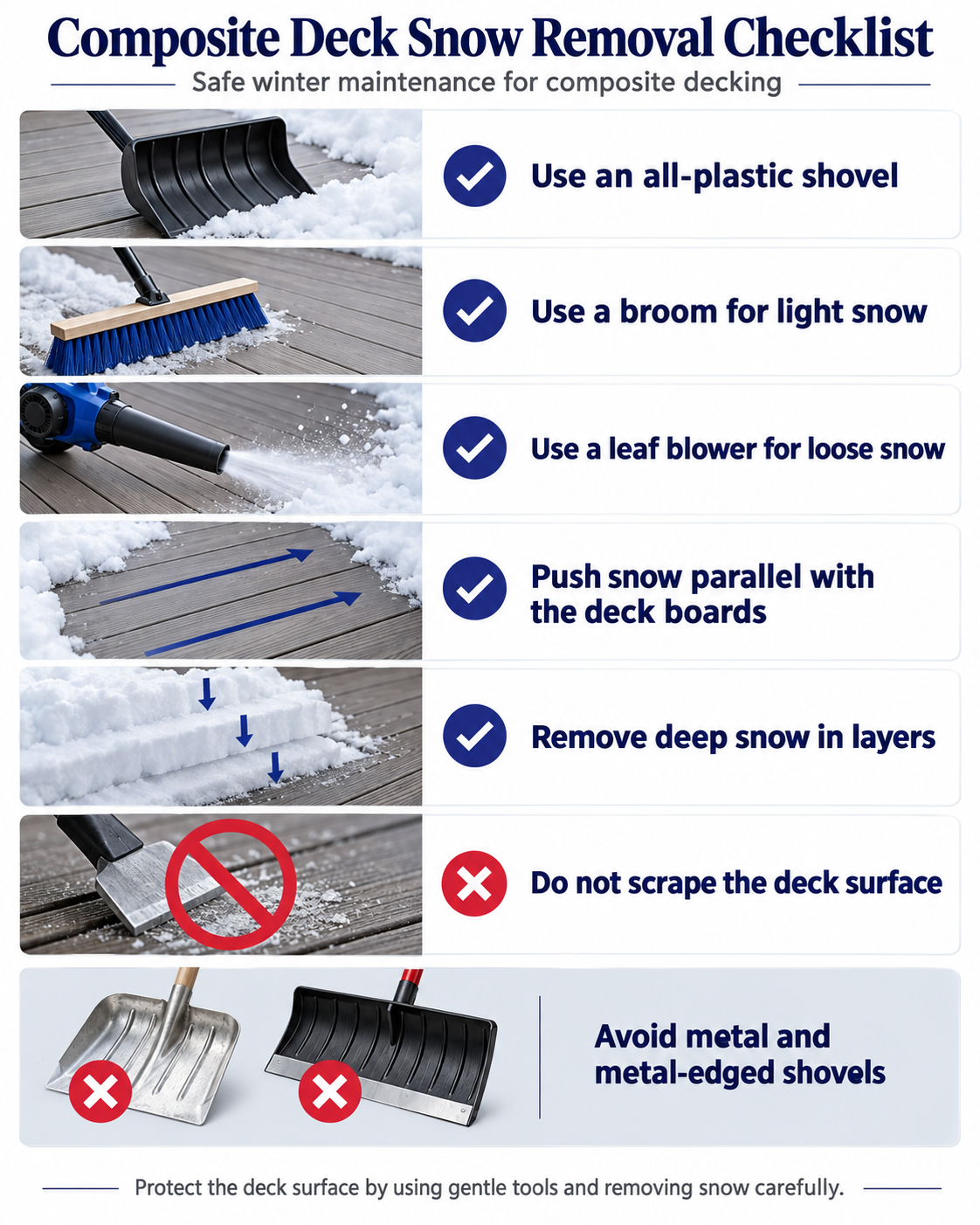
Before you remove snow from composite decking, remember:
- Use an all-plastic snow shovel.
- Avoid metal leading edges.
- Inspect the shovel for stones and grit.
- Sweep or blow away light powder when possible.
- Shovel parallel with the deck boards.
- Remove deep snow in layers.
- Use short, controlled pushes.
- Do not scrape the boards clean.
- Never chop bonded ice.
- Avoid metal scrapers and ice picks.
- Check manufacturer care instructions before using other winter products.
- Keep a separate shovel for deck use.
These habits help protect the decking surface through repeated winter storms.
Protect Your Composite Deck Through Winter
The safest way to remove snow from composite decking comes down to the tool and your technique.
Use an all-plastic shovel, work with the direction of the boards, remove heavy snow in layers, and stop before you begin scraping frozen material.
Most avoidable winter damage happens when homeowners treat a composite deck like a concrete driveway.
Winter snow, slush, dirt, and deicer residue can leave the deck surface looking dull once temperatures rise. When the weather warms up, follow our guide on how to clean composite decking for the proper tools, cleaners, and washing methods.
Premium Decking Supply carries composite and PVC decking, railing, fasteners, lighting, and other outdoor living materials for homeowners and contractors. We ship decking materials nationwide and can help you find online the right decking products for your next deck project.
Frequently Asked Questions About Removing Snow From Composite Decking
Yes. Use an all-plastic snow shovel without a metal leading edge. Push gently and work in the direction of the deck boards when possible. Avoid scraping frozen material from the surface.
Use a soft broom or leaf blower for light powder. For deeper snow, use an all-plastic shovel and remove the snow in manageable layers. Avoid metal tools and aggressive scraping.
Yes. Plastic is safer than metal, but it can still cause damage if stones are trapped under the blade or you scrape with excessive pressure. Inspect the shovel and deck surface before starting.
Shovel parallel with the deck boards whenever the layout allows. This reduces the chance that the shovel will catch board edges or repeatedly strike the gaps between boards.
Avoid using ice choppers or similar impact tools on composite decking. Chopping, striking, or prying at bonded ice can damage the finished surface. Let the ice loosen using a manufacturer-approved winter-care method.